I've written about Jeanne Balibar's idiosyncratic ways before (go here for some background) but she just topped herself — and that wasn't easy. At the recent Césars awards ceremony in Paris, she came in to announce the winner for best music. She started by saying "I'm really honored to announce the next César. I'll let you guess what it's for thanks to this short interlude."
And then she proceeded to sing a Baudelaire poem, augmented with pig noises. Make sure you watch the whole thing, as it gets crazier and crazier as it goes along. Hosts Valérie Lemercier and comedian Gad Elmaleh look startled, which of course adds to the scene's surreal tone. (The shots of the audience are choice as well.)
Showing posts with label off the charts. Show all posts
Showing posts with label off the charts. Show all posts
Saturday, March 06, 2010


Wednesday, June 24, 2009
Countdown to ecstasy
My preview of tonight's installment of Our Hit Parade is in the New York Post.
Modelled after the old radio and TV show Your Hit Parade, this monthly cavalcade of stars performing current chart-toppers is a real hoot, and usually includes a countdown, games, dances, audience participation (willing or not) and a certain amount of nudity.
In addition to the core trio of Kenny Mellman, Bridget Everett and Neal Medlyn, tonight's guests include the Magnetic Fields' Stephin Merritt and Claudia Gonson, Randy Harrison, Jackie Hoffman and Molly Pope. See you at Joe's Pub!
Modelled after the old radio and TV show Your Hit Parade, this monthly cavalcade of stars performing current chart-toppers is a real hoot, and usually includes a countdown, games, dances, audience participation (willing or not) and a certain amount of nudity.
In addition to the core trio of Kenny Mellman, Bridget Everett and Neal Medlyn, tonight's guests include the Magnetic Fields' Stephin Merritt and Claudia Gonson, Randy Harrison, Jackie Hoffman and Molly Pope. See you at Joe's Pub!
Saturday, January 17, 2009
The wit and wisdom of Alphabeat
I've listened to Alphabeat's This Is Alphabeat a lot in the past few months. In fact, it's one of the few albums I've listened to repeatedly all the way through. While the Danes' wicked way with hooks obviously is the primary appeal, I've also come to really appreciate their lyrics.
One song really encapsulates the Alphabeat style: "10,000 Nights." Disregarding the conventional verse-chorus-verse structure, the melody is plain addictive (and look at the adorably dorky dance moves in the video), but it's the lyrics that bring it all home: Such a poetic inanity—or is that inane poetry?—is rare, even in the kind of pop I love. See for yourself in this analysis of the entire song (I'll skip repeated lines):
I was not looking for arty-farty love
Hmm, arty-farty feels like a remote possibility if you're in a band like Alphabeat but okay, if you insist on stating the obvious, I'm with you. But why not artsy-fartsy instead of the awkward arty-farty? Would it have thrown off the meter? Is the gassy echo a reference to Serge Gainsbourg's cult novel Evguénie Sokolov?
I wanted someone to love completely
Someone more than weekly
We're starting to get somewhere: No pseudo-intellectual hipsters need apply, and no behaving like a Simenon character with a weekly prostitute habit.
I was looking for a decent boy
Despite visual evidence suggesting the opposite would make more sense, Stine sings this line, not Anders.
For a tender glance
For a safety dance
First meta reference to another song, ie Men Without Hats' "The Safety Dance." Alphabeat slyly suggests it learned English by listening to the radio.
The wuthering heights
And the stormy nights
This is the one-two punch that slays me every single time. It could be a Bronte reference in the first line but I don't think so, meaning we've got another pop allusion, this time to Kate Bush (which makes you revisit the first line: perhaps someone in Alphabeat would like arty-farty after all). And then we have the stormy nights. No verb, just minimalist description. Amazing.
You give me 10,000 nights of thunder
But I will give them all back to you
But why will you give them back? Don't you like the other person anymore? Also do you realize that 10,000 nights is 27 years??? These two lines are bewildering and insanely wonderful.
Cause you're so ooh, you're so aah, you're so cool
This doesn't help at all. Anders is giving back the nights—and not just any nights: nights of thunder—because the object of his affection is…cool? The way Anders grasps for words before settling down for "cool" is rather endearing.
You came like a thief in the night and stole my heart
Like a solitude erasure
Like an elevator
My three favorite lines of the year, no contest. Listening to the song, I thought Stine and Anders sang "Like a solitude eraser"—referring to the thief—but all the lyrics sites I consulted have "erasure." I'm not sure which one I prefer, though "erasure" somehow has a more definitive side to it. The lines are happy but a certain darkness creeps in. That elevator thing, however, is completely cryptic—like something out of a song those bearded indie-rock kids enjoy so much. Is this an example of catachresis? Discuss.
And I know we'd do anything for love
And it is you and me
For all eternity
Whoa, Stine's going all Tristan and Isolde on us! What happened to the arty-farty safety dance?
It feels like 10,000 nights of thunder
When I've spent one with you
A-ha! They didn't literally mean 27 years. Alphabeat is in absolute mastery of all the rhetorical tools at the disposal of a pop lyricist. (Remember the use of analogy in the "solitude erasure/elevator" combo?)
'Cause you're so ooh, you're so aah, you're so cool
You're so super-supremely ba-ba-di-oh
And one of these tools seems to be nonsense, which Stine uses to express the fact that her infatuation is so strong, it prevents her from articulating her thoughts, just like Anders and his bumbling "You're so ooh, so aah." I like the use of the mirror image, plus for some reason it all reminds me of "Bibbidi Bobbidi Boo" from Cinderella.
And baby baby you're irresistible and I'm insatiable
Yeah love is an ocean of sweet emotion
While Alphabeat is a PG band, the first line suggests Anders has needs, like all young men his age. But he immediately drops that sensitive subject and reassures us that he understands the real force to be reckoned with is love. All's well that ends well.
One song really encapsulates the Alphabeat style: "10,000 Nights." Disregarding the conventional verse-chorus-verse structure, the melody is plain addictive (and look at the adorably dorky dance moves in the video), but it's the lyrics that bring it all home: Such a poetic inanity—or is that inane poetry?—is rare, even in the kind of pop I love. See for yourself in this analysis of the entire song (I'll skip repeated lines):
I was not looking for arty-farty love
Hmm, arty-farty feels like a remote possibility if you're in a band like Alphabeat but okay, if you insist on stating the obvious, I'm with you. But why not artsy-fartsy instead of the awkward arty-farty? Would it have thrown off the meter? Is the gassy echo a reference to Serge Gainsbourg's cult novel Evguénie Sokolov?
I wanted someone to love completely
Someone more than weekly
We're starting to get somewhere: No pseudo-intellectual hipsters need apply, and no behaving like a Simenon character with a weekly prostitute habit.
I was looking for a decent boy
Despite visual evidence suggesting the opposite would make more sense, Stine sings this line, not Anders.
For a tender glance
For a safety dance
First meta reference to another song, ie Men Without Hats' "The Safety Dance." Alphabeat slyly suggests it learned English by listening to the radio.
The wuthering heights
And the stormy nights
This is the one-two punch that slays me every single time. It could be a Bronte reference in the first line but I don't think so, meaning we've got another pop allusion, this time to Kate Bush (which makes you revisit the first line: perhaps someone in Alphabeat would like arty-farty after all). And then we have the stormy nights. No verb, just minimalist description. Amazing.
You give me 10,000 nights of thunder
But I will give them all back to you
But why will you give them back? Don't you like the other person anymore? Also do you realize that 10,000 nights is 27 years??? These two lines are bewildering and insanely wonderful.
Cause you're so ooh, you're so aah, you're so cool
This doesn't help at all. Anders is giving back the nights—and not just any nights: nights of thunder—because the object of his affection is…cool? The way Anders grasps for words before settling down for "cool" is rather endearing.
You came like a thief in the night and stole my heart
Like a solitude erasure
Like an elevator
My three favorite lines of the year, no contest. Listening to the song, I thought Stine and Anders sang "Like a solitude eraser"—referring to the thief—but all the lyrics sites I consulted have "erasure." I'm not sure which one I prefer, though "erasure" somehow has a more definitive side to it. The lines are happy but a certain darkness creeps in. That elevator thing, however, is completely cryptic—like something out of a song those bearded indie-rock kids enjoy so much. Is this an example of catachresis? Discuss.
And I know we'd do anything for love
And it is you and me
For all eternity
Whoa, Stine's going all Tristan and Isolde on us! What happened to the arty-farty safety dance?
It feels like 10,000 nights of thunder
When I've spent one with you
A-ha! They didn't literally mean 27 years. Alphabeat is in absolute mastery of all the rhetorical tools at the disposal of a pop lyricist. (Remember the use of analogy in the "solitude erasure/elevator" combo?)
'Cause you're so ooh, you're so aah, you're so cool
You're so super-supremely ba-ba-di-oh
And one of these tools seems to be nonsense, which Stine uses to express the fact that her infatuation is so strong, it prevents her from articulating her thoughts, just like Anders and his bumbling "You're so ooh, so aah." I like the use of the mirror image, plus for some reason it all reminds me of "Bibbidi Bobbidi Boo" from Cinderella.
And baby baby you're irresistible and I'm insatiable
Yeah love is an ocean of sweet emotion
While Alphabeat is a PG band, the first line suggests Anders has needs, like all young men his age. But he immediately drops that sensitive subject and reassures us that he understands the real force to be reckoned with is love. All's well that ends well.
Wednesday, January 07, 2009
And the hits keep on coming
Back in December, I raved about Our Hit Parade, a demented revue I saw at the Zipper. The brain trust behind the event—Bridget Everett, Kenny Mellman and Neal Medlyn—has now started a companion blog of the same name, which combines two of my favorite things: super-commercial pop songs and a twisted downtown sensibility.
The next edition of Our Hit Parade is at the Zipper on January 31. See you there.
The next edition of Our Hit Parade is at the Zipper on January 31. See you there.
Wednesday, November 19, 2008
Carla sings a new tune on American TV
There's many sentences I thought I'd never hear. Yet one of them rolled out—not so smoothly since it involved French words—of Matt Lauer's mouth today: "And here she is, the First Lady of France, with her new song…"
Lo and behold, Carla Bruni-Sarkozy was on the Today Show this morning, playing two tracks from her latest album. And yes, the link includes video evidence! We are reaching new levels of surrealism here, people. (I typed "my friends" at first but then I remembered that 1. not all of you are my friends and 2. just yesterday the Sheila finished a sentence with "my friends" and I asked her if she was turning into John McCain.)
French readers should correct me if I'm wrong, but I'm pretty sure Carla didn't perform in France to plug the album. Something or other about it not being dignified. Yeah, whatevs. Clearly the dignity rules are suspended on this side of the Atlantic. It's like eating sweets: It doesn't count when you do it on vacation.
Lo and behold, Carla Bruni-Sarkozy was on the Today Show this morning, playing two tracks from her latest album. And yes, the link includes video evidence! We are reaching new levels of surrealism here, people. (I typed "my friends" at first but then I remembered that 1. not all of you are my friends and 2. just yesterday the Sheila finished a sentence with "my friends" and I asked her if she was turning into John McCain.)
French readers should correct me if I'm wrong, but I'm pretty sure Carla didn't perform in France to plug the album. Something or other about it not being dignified. Yeah, whatevs. Clearly the dignity rules are suspended on this side of the Atlantic. It's like eating sweets: It doesn't count when you do it on vacation.
Saturday, October 25, 2008
Róisín and the amazing technicolor overcoats
 There's concerts, and then there's events. Róisín Murphy at Mansion tonight was definitely in the latter category. I've seen lots of pop extravaganzas over the years, but this one made me feel as if my brain had imploded. In a good way, of course.
Róisín is the Tilda Swinton of pop: Beyond their blonde palor, the two women share a sense of eccentric style and quirky tastes, as well as a gift to incorporate the experimental into the mainstream and an earthy sense of humor that sets them well aside from the safe discourse of most performers. Even when they venture into the commercial realm—Tilda Swinton in The Chronicles of Narnia, say, or Róisín recording a disco anthem—there's something completely sui generis about the way they go about it. The video for "Movie Star," for instance, pays tribute to both Leigh Bowery and John Waters's Multiple Maniacs, with Róisín getting molested by a lobster.
But back to last night.
The sense that something special was brewing was clear as soon as the Sheila and I rounded the corner of W 28th St: the entire block was taken up by the biggest line I've seen for a show in years, if not ever; inside Mansion, a sprawling deluxe establishment with plenty of nooks and crannies, chandeliers and disco balls, the bilevel main floor was already packed to the gills (the crowd was 80% male, perhaps because the show was presented by the Saint at Large).
Things started off with a pounding 4/4 beat, which turned out into "Cry Baby," the most Moroderish track on the singer's last album, Overpowered. She showed up wearing a shiny gold jacket over black leggings, a long-sleeved, skintight white top, vertiginous heels, black leather gloves and shades (which, of course, she took off on the line "Tired of wiping the tears from your eyes"). On the next song Róisín traded the jacket for a fringed leather one.
The jacket and accessories switches went on until about halfway through, when she stepped it up: She attached a fake hump to her back, then covered it with an enormous fluffy Big Bird–like cape, topped off with a large dinner-plate hat. There was also a large white angel-wing-shaped fur overcoat matched with a black fetish cap. And a deep pink/red hat with a face on it. And ballooning gold overalls with corset lacing at the back. And a dress that looked like it had been built by Frank Gehry. And more hats and gloves and shoes. There was a change for every song, and the best part is the music never stopped—it was like the concert version of a mix-CD.
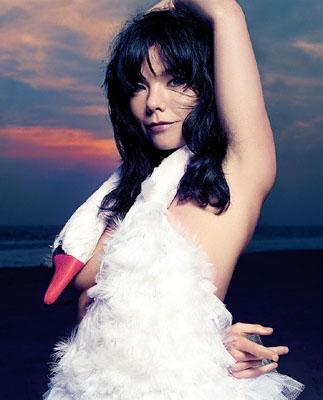
The craziest outfit may well have been for "Overpowered": a tartan deer cape (with an actual deer-like animal precariously perched on top of the shoulders like some kind of Surrealistic stole) topped with an antler hat, like an even more demented version of Björk's swan dress. At the end of the song, Róisín collapsed to the floor, taking out the garment as she did and cradling the animal. It was completely bizarre and completely riveting.
And yet she came back and topped it! On the finale, an explosive version of "Rama Lama (Bang Bang)," she wore a foofy coat made of real chicken feathers, then at the end started a brawl with her backup singers, the three women tumbling to the floor (again!) and exchanging fisticuffs.
Through 90 minutes, Róisín never let up: This woman knows how to work a stage. Yet far from the over-rehearsed aerobicized vulgarity all too common among American pop and R&B stars, she danced like a club girl: There were just enough poses and coordinated moves with her backup singers to indicate that careful thought had gone into it all, but her goofy energy was that of someone who's logged miles on a real dance-floor. Plus she indulged in energetic headbanging a few times, blonde hair flying all over.
Someone's already posted some videos from last night, which should give you a vague idea of the fever-pitch excitment of it all: "Cry Baby", "Dear Miami," "Overpowered" (with the deer!), "Forever More" and "Movie Star." I'm sure more will be posted once the revelers wake up.
Finally, I've talked a lot about the visuals, but Róisín has got to be one of the most underrated singers around, with a sexy, smokey tone that's all her own. Check out this live rendition of Moloko's "The Time Is Now" on a British TV show: just gorgeous. "Let Me Know" (which was disco heaven last night) ain't too shabby either.
Saturday, July 05, 2008
Apocalypse now
Words like "genius" and "great"are thrown about regularly these days, but in the case of Die Soldaten at Lincoln Center Festival, they should be used literally. If you're reading these lines, you are likely to have an interest in the arts, so the message is simple: go.
Every time I'm brought down by one more mediocre, bland, utterly pointless show—they are even more lethal than the truly bad ones—I wonder why I'm putting myself through this rigmarole over and over again. Why, why do I feel the urge to stagger back home at 11pm on that slowpoke F train after one more disappointing evening out? It's because as with everything, your chances of hitting on something good are infinitesimal. Just ask anybody trying to date in New York. The odds are against you, so you have to kiss a lot of frogs to find the one prince—in the arts, something that transports you to another realm. You might call it transcendence, and when you find it, it makes up for all these wasted hours. That is what Die Soldaten provided on Thursday night, when I was lucky to see a dress rehearsal of that mammoth piece.
On paper, Alois Bernd Zimmermann's 1950s opera looks pretty austere, and it is, of course: 12-tone music isn't my idea of an elevator to bliss; add a storyline dealing with the use and abuse of a young woman by various men in wartime, and Die Soldaten had the making of a big spoon of castor oil. Honestly, I think it'd still be that for me without this new extraordinary staging (I can't say I will ever listen to the music at home for instance).
Lincoln Center Festival threw its financial might behind importing David Pountney's awe-inspiring production from the 2006 Ruhr Triennale, in which the audience sits on metal bleachers that slowly move along a gigantically long stage—in our case, set up in the main hall of the Park Avenue Armory—while the no-less gigantic 110-person orchestra sits on the side. (This helpful video preview explains the basic idea.)
As we made our way along the stem of the T-shaped stage, an optical illusion made it seem as if it was the actors who were on a treadmill while we were static. Pountney would place his cast along the whole length, making for an incredible impression of depth of space and even time. But the large scale was only part of the picture: The particular genius of Pountney's concept is that you get both a sense of mind-numbing grandeur and, because the action moves in and out of focus, so to speak, one of crushing intimacy—we were lucky enough to sit right next to the stage and so we were just about eight feet away from the cast at some of the most harrowing moments.
Die Soldaten is an ultra-rare case of a highly conceptual staging that brings everything out of the work and more, transforming the way we even consider the interconnection between art and life. It threw my head into a major Exorcist 360 spin. I'm pretty sure that I forgot to breathe during the last ten minutes, when the gruesome plot reaches its apex and at least four drummers in the orchestra are going at it in unison (the din was so ferocious that I could see the other musicians covering up their ears with their hands). A local director I know was sitting a few rows ahead of us and looked shellshocked afterwards.
Total hardcore!
Every time I'm brought down by one more mediocre, bland, utterly pointless show—they are even more lethal than the truly bad ones—I wonder why I'm putting myself through this rigmarole over and over again. Why, why do I feel the urge to stagger back home at 11pm on that slowpoke F train after one more disappointing evening out? It's because as with everything, your chances of hitting on something good are infinitesimal. Just ask anybody trying to date in New York. The odds are against you, so you have to kiss a lot of frogs to find the one prince—in the arts, something that transports you to another realm. You might call it transcendence, and when you find it, it makes up for all these wasted hours. That is what Die Soldaten provided on Thursday night, when I was lucky to see a dress rehearsal of that mammoth piece.
On paper, Alois Bernd Zimmermann's 1950s opera looks pretty austere, and it is, of course: 12-tone music isn't my idea of an elevator to bliss; add a storyline dealing with the use and abuse of a young woman by various men in wartime, and Die Soldaten had the making of a big spoon of castor oil. Honestly, I think it'd still be that for me without this new extraordinary staging (I can't say I will ever listen to the music at home for instance).
Lincoln Center Festival threw its financial might behind importing David Pountney's awe-inspiring production from the 2006 Ruhr Triennale, in which the audience sits on metal bleachers that slowly move along a gigantically long stage—in our case, set up in the main hall of the Park Avenue Armory—while the no-less gigantic 110-person orchestra sits on the side. (This helpful video preview explains the basic idea.)
As we made our way along the stem of the T-shaped stage, an optical illusion made it seem as if it was the actors who were on a treadmill while we were static. Pountney would place his cast along the whole length, making for an incredible impression of depth of space and even time. But the large scale was only part of the picture: The particular genius of Pountney's concept is that you get both a sense of mind-numbing grandeur and, because the action moves in and out of focus, so to speak, one of crushing intimacy—we were lucky enough to sit right next to the stage and so we were just about eight feet away from the cast at some of the most harrowing moments.
Die Soldaten is an ultra-rare case of a highly conceptual staging that brings everything out of the work and more, transforming the way we even consider the interconnection between art and life. It threw my head into a major Exorcist 360 spin. I'm pretty sure that I forgot to breathe during the last ten minutes, when the gruesome plot reaches its apex and at least four drummers in the orchestra are going at it in unison (the din was so ferocious that I could see the other musicians covering up their ears with their hands). A local director I know was sitting a few rows ahead of us and looked shellshocked afterwards.
Total hardcore!
Saturday, September 29, 2007
Look back in wonder, part 3
 I realize I said this would be an occasional series and I just wrote about seeing Saint Etienne a few days ago, but I could not let this particularly anniversary go by: On September 29, 1989, I saw the Jesus Lizard for the first time. Oh mama!
Back then I was in grad school at Rutgers in New Brunswick, so I saw a lot of shows at the Court Tavern, a local dingy, super-low-ceilinged basement venue. Of all the good gigs I caught there (Mudhoney, Laughing Hyenas, Tiny Lights, the A-Bones, Beme Seed), none made as much of an impact.
According to the Touch & Go site, the Jesus Lizard played its first-ever show on July 1, 1989, in Chicago, so the band must have been on its first tour when I saw it. And maybe a band can only have that sense of unhinged mania on its first tour; later, you learn that it's probably a good idea not to get wasted—in every sense of the word—every night. The Lizard mixed a sense of threatening, quasi-psychopathic rage with a surprisingly disciplined reptilian crawl forward (the band wasn't big on BPMs). The explosive rhythm section of Mac McNeilly and David Sims plus the economical Duane Denison on guitar plus one of the best frontmen ever in David Yow: These guys were the perfect rock unit.
It's too bad that Yow is now remembered, if at all, as that guy who used to drop his pants during shows. And yes he did expose himself during "Tight ’n Shiny" at the Court, but it's not like he was just letting it all hang out, as it were: Like everything else the Lizard did, he went further by pulling and stretching and choking himself in a way that would have been painful if he hadn't seemed to be in some kind of trance. Some people speak in tongue, others become rock singers.
Another thing about Yow: He was a man, not an overgrown boy indulging in rock because it's a cool thing to do. He was around 29 in 1989 (he'd already been in Scratch Acid in Texas), and he had a kind of beat-up gravitas. When he got in your face at a show, it was scary because you felt that he was old enough to know better—he just didn't care to know better.
The next time I saw the Jesus Lizard was on April 28, 1990, at Maxwells, where it was opening for some new Seattle band called Nirvana. Nirvana didn't stand a chance following up the Lizard; I left after maybe four or five songs by Cobain & Co. In retrospect of course I regret not staying longer for Nirvana, a band I never saw again, but that night in 1990, nobody could play after the Jesus Lizard.
That particular bill illustrated a dichotomy very much of its time: grunge vs pigfuck. I preferred pigfuck, especially in its midwestern incarnation, which included the Lizard, Killdozer and pretty much the entire Amphetamine Reptile roster. I just loved that amorphous genre's violent misanthropy and its strong strain of elaborate artiness, for lack of a better word (best example: Killdozer); the music was a lot more fucked-up, aggressive, and complex—and a lot less predictable—than grunge, which relied way too much on tension-and-release dynamics that quickly became generic. Plus pigfuck didn't wallow in self-obsessed misery: Pigfuck was all about taking it out on others!
The Jesus Lizard released the Pure EP in 1989 but I'm going to forego historical purity and post tracks from its 1991 album Goat, the studio album that to me best captures the mix of genius precision and batshit abandon that characterized the band live, and one of the best albums of the 90s. Here's a sensational three-track consecutive sequence from it.
Jesus Lizard "Karpis"
Jesus Lizard "South Mouth"
Jesus Lizard "Lady Shoes"
Sunday, July 01, 2007
Precision fun
The last time I was at Giants Stadium was to see Liverpool duke it out with AC Milan, and the time before that was for ’N Sync. I guess I just don't hang out in the Meadowlands that much. But on Saturday, I spent two of the best hours of the year in that godforsaken corner of New Jersey—at a drum & bugle competition!
The only surprise is that it took me so long to finally see this type of event—after all, I'm a huge fan of precision ensembles, from Busby Berkeley movies to the Rockettes, and I love high-school marching bands. And of course Saturday's event was also part of the ongoing "Americanization of Elisabeth" campaign; there sure aren't any drum contests in France, a highly individualistic country where the only successful synchronized events seem to be strikes.
Anyhoo, Saturday… We started off with the Jersey Surf, an endearing, scrappy category 2 corps that I enjoyed watching if only because I knew it'd help my untrained eyes to better appreciate the heady perfection that'd come later from the more accomplished ensembles. Drum & bugle has militaristic origins but they've been channeled, as if the case with pretty much everything in America, into pure entertainment. Uniforms, yes, but with sequins! Shakos, sure, but with lots of feathers! Rifles, absolutely, but thrown up high in the air like you just don't care! (If America exorcised its military jones through drum & bugle instead of ill-fated excursions to Iraq, we might be in a better place.) And of course, the metal fan in me was psyched by the sheer volume of it all: When a corps lets loose, it's gloriously loud.
My two favorites were Carolina Crown and Phantom Regiment. Carolina Crown's guard overcame silly outfits that made it look like a bunch of extras from Cats but then turned out to play a narrative purpose when the kids enacted a stylized horse race to the tune of the William Tell Overture played full speed ahead. (Compare with the Boston Crusaders, who lugged easels around during their entire Picasso-themed routine but didn't really use them.) No wonder the Crown got the biggest ovation, followed by boos when it finished in third place. As for Phantom Regiment, it came up with my favorite purely musical moment, making Philip Glass' 1000 Airplanes on the Roof sound like 1000 airplanes taking off.
Back home, the Sheila pointed out that she grew up watching Edinburgh's Military Tattoo, which was broadcast on prime time in Australia and which does seem to get close to what I'd just seen, albeit with a stronger international component. And lo and behold, a bit of poking around quickly unearthed an amazing Military Tattoo performance by the Top Secret Drum Corps from Basel—so secret, its bass drums are painted black. Just check out that stick action! I had no idea the Swiss had it in them.
The only surprise is that it took me so long to finally see this type of event—after all, I'm a huge fan of precision ensembles, from Busby Berkeley movies to the Rockettes, and I love high-school marching bands. And of course Saturday's event was also part of the ongoing "Americanization of Elisabeth" campaign; there sure aren't any drum contests in France, a highly individualistic country where the only successful synchronized events seem to be strikes.
Anyhoo, Saturday… We started off with the Jersey Surf, an endearing, scrappy category 2 corps that I enjoyed watching if only because I knew it'd help my untrained eyes to better appreciate the heady perfection that'd come later from the more accomplished ensembles. Drum & bugle has militaristic origins but they've been channeled, as if the case with pretty much everything in America, into pure entertainment. Uniforms, yes, but with sequins! Shakos, sure, but with lots of feathers! Rifles, absolutely, but thrown up high in the air like you just don't care! (If America exorcised its military jones through drum & bugle instead of ill-fated excursions to Iraq, we might be in a better place.) And of course, the metal fan in me was psyched by the sheer volume of it all: When a corps lets loose, it's gloriously loud.
My two favorites were Carolina Crown and Phantom Regiment. Carolina Crown's guard overcame silly outfits that made it look like a bunch of extras from Cats but then turned out to play a narrative purpose when the kids enacted a stylized horse race to the tune of the William Tell Overture played full speed ahead. (Compare with the Boston Crusaders, who lugged easels around during their entire Picasso-themed routine but didn't really use them.) No wonder the Crown got the biggest ovation, followed by boos when it finished in third place. As for Phantom Regiment, it came up with my favorite purely musical moment, making Philip Glass' 1000 Airplanes on the Roof sound like 1000 airplanes taking off.
Back home, the Sheila pointed out that she grew up watching Edinburgh's Military Tattoo, which was broadcast on prime time in Australia and which does seem to get close to what I'd just seen, albeit with a stronger international component. And lo and behold, a bit of poking around quickly unearthed an amazing Military Tattoo performance by the Top Secret Drum Corps from Basel—so secret, its bass drums are painted black. Just check out that stick action! I had no idea the Swiss had it in them.
Sunday, March 18, 2007
Young the restless
It was pretty fitting that a blizzard hit New York Friday night; walking down 10th Avenue in whiteout conditions added a layer of deep-freeze fun to Ann Liv Young's retelling of Snow White at the Kitchen.
From what I gather, many—including, it would appear, some of her own (now ex) collaborators—think Ann Liv Young is a fraud who's getting press and European grants solely because her shows are in-your-face raunchy. She usually gets reviewed in dance sections but there's relatively little dancing (or what is traditionally thought of as dancing) in the two pieces by her that I've now seen, and it can be very crude, owing more to 1980s music videos and cheerleading routines to Judson or Martha or Twyla or whoever the hell it is NY choreographers look up to these days. The overall aesthetic is rough and amateurish, but you can't tell if this is a deliberate choice executed with canny precision or the result of a certain haplessness on Young's part. Likely, it's a mix of both, which is one of the reasons I like her shows so much.
While Michael, performed at Dance Theater Workshop in 2005, was mondo trailer trash, Snow White is a gonzo-karaoke Twilight of the Fairy Tales. The cast of three—Young, Liz Santoro and Michael Guerrero—already was onstage, wearing eye-shredding white leotards and black ankle-high Reeboks, as we took our seats. Santoro in particular looked as if she was dreading what was about to happen; rarely have I seen so much anxious boredom ooze out of a performer doing strictly nothing.
They started things off by singing along to Michael Jackson's "Smooth Criminal"; the effect was oddly powerful, with Young in particular looking magnetically feral. In another highlight, Snow White (Young) got fucked by the Prince (Santoro, sprouting a dildo attached to her hips with pink duct tape) to the strains of the original version of "Someday My Prince Will Come." At one point, the Prince berated Snow White in French ("You sucked off all the dwarfs, etc."); at another, Young explained her creative process, which seems to mainly involve harshing on her team, "like when I tell Liz she's a dyke with no singing ability. The next day, she's impeccable." The ensemble of three dressed and undressed constantly, going from one hideous getup to another, while Young, clearly in charge, requested water in the middle of a dance, petulantly barked directions and bossed the other two around.
The entire time, Young's expressions ranged from bratty to angry to frustrated to bored to resentful, as if she was pissed off with her own show and couldn't wait for it to end. It didn't matter if she was play-acting or not and it's this ambiguity that's her strength, this confusion that makes her so bewilderingly interesting. Does it matter if we know what's planned or not? Young is very clever at making it all look like a gigantic car crash in progress but she let us in on her self-awareness with a brilliant idea toward the end, when the three performers sang along to a recording session of the vocals to the Beach Boys' "Help Me, Rhonda" complete with studio fuck-ups and interruptions.
Young's choices challenge ours as supposedly hip audience members: Okay, so we've taken an endorsement of junk aesthetics as far as it will go—now what? Cannily, her perpetually angry, perpetually frustrated mix of self-flagellation and self-satisfaction mirrors that of arty, lefty America.
Snow White plays again at the Kitchen on March 21–24. You'll be hard-pressed to find a better way to spend $12 this year.
From what I gather, many—including, it would appear, some of her own (now ex) collaborators—think Ann Liv Young is a fraud who's getting press and European grants solely because her shows are in-your-face raunchy. She usually gets reviewed in dance sections but there's relatively little dancing (or what is traditionally thought of as dancing) in the two pieces by her that I've now seen, and it can be very crude, owing more to 1980s music videos and cheerleading routines to Judson or Martha or Twyla or whoever the hell it is NY choreographers look up to these days. The overall aesthetic is rough and amateurish, but you can't tell if this is a deliberate choice executed with canny precision or the result of a certain haplessness on Young's part. Likely, it's a mix of both, which is one of the reasons I like her shows so much.
While Michael, performed at Dance Theater Workshop in 2005, was mondo trailer trash, Snow White is a gonzo-karaoke Twilight of the Fairy Tales. The cast of three—Young, Liz Santoro and Michael Guerrero—already was onstage, wearing eye-shredding white leotards and black ankle-high Reeboks, as we took our seats. Santoro in particular looked as if she was dreading what was about to happen; rarely have I seen so much anxious boredom ooze out of a performer doing strictly nothing.
They started things off by singing along to Michael Jackson's "Smooth Criminal"; the effect was oddly powerful, with Young in particular looking magnetically feral. In another highlight, Snow White (Young) got fucked by the Prince (Santoro, sprouting a dildo attached to her hips with pink duct tape) to the strains of the original version of "Someday My Prince Will Come." At one point, the Prince berated Snow White in French ("You sucked off all the dwarfs, etc."); at another, Young explained her creative process, which seems to mainly involve harshing on her team, "like when I tell Liz she's a dyke with no singing ability. The next day, she's impeccable." The ensemble of three dressed and undressed constantly, going from one hideous getup to another, while Young, clearly in charge, requested water in the middle of a dance, petulantly barked directions and bossed the other two around.
The entire time, Young's expressions ranged from bratty to angry to frustrated to bored to resentful, as if she was pissed off with her own show and couldn't wait for it to end. It didn't matter if she was play-acting or not and it's this ambiguity that's her strength, this confusion that makes her so bewilderingly interesting. Does it matter if we know what's planned or not? Young is very clever at making it all look like a gigantic car crash in progress but she let us in on her self-awareness with a brilliant idea toward the end, when the three performers sang along to a recording session of the vocals to the Beach Boys' "Help Me, Rhonda" complete with studio fuck-ups and interruptions.
Young's choices challenge ours as supposedly hip audience members: Okay, so we've taken an endorsement of junk aesthetics as far as it will go—now what? Cannily, her perpetually angry, perpetually frustrated mix of self-flagellation and self-satisfaction mirrors that of arty, lefty America.
Snow White plays again at the Kitchen on March 21–24. You'll be hard-pressed to find a better way to spend $12 this year.
Saturday, December 09, 2006
It's astounding, time is fleeting…
…madness takes its toll. And boy, did it!
Based on a glowing recommendation from my colleague Adam Feldman, I dropped by Joe's Pub Friday evening to check out Leslie Kritzer Is Patti LuPone at Les Mouches, an unwieldy title that turned out to hide a dynamite show, as Ed Sullivan would put it.
The basic concept is that Kritzer reproduces Patti LuPone's last set at Les Mouches, a Chelsea boîte where Patti held a Saturday residency for 30 weeks in 1980—performing right after appearing in Evita on Broadway. Oddly, this is the second show I've seen in the past couple of months where a performer has turned a nominal homage into a memorable, completely original evening. And Kritzer had set herself a challenge even bigger than the one Terese Genecco faced in her tribute to Frances Faye, because Genecco dealt with Faye in general, telling the audience about her subject's life for instance; Kritzer, however, is reproducing a particular set's song list and banter, making it trickier to both avoid simply mimicking her model and put her own stamp on the material. That she delivers the most high-octane performance I've seen in ages must be credited to her powerhouse voice, interpretative chops and deadly comic timing—and those are her own and nobody else's.
Making her grand entrance with "She's a Latin from Manhattan," Kritzer hilariously emphasized LuPone's tendency to slur lyrics into complete unintelligibility, but she dropped the strict emulation quickly and somehow managed to appropriate songs indelibly associated with Her Royal Pattiness, like "Meadowlark" and "Don't Cry for Me, Argentina."
A side result of listening to this recreation is that I was once again struck by the porous barriers between genres in 1980. Patti was doing "Love for Sale" but also "Superman" and "Because the Night," rock songs that were newish at the time—compare this to contemporary cabaret artists who pat themselves on the back for dipping into the back catalogs of Randy Newman, Laura Nyro or Joni Mitchell. And let's not forget the time-warp experience of "Heaven Is a Disco," a 1977 song by Paul Jabara—author of the immortal "Last Dance" and "No More Tears (Enough Is Enough)"—that suddenly turned Joe's into Studio 54.
After looking her up, I realized that I had actually seen Kritzer before—in a 2000 revival of Godspell at the Theater at St Peter's that also starred then-unknowns Barrett Foa and Capathia Jenkins. I can't honestly say I had singled out Kritzer at the time, essentially because the entire cast of that zippy production was surprisingly good.
And while we're on the subject of Patti LuPone, I may have to check out Jet Blue's fares: She and Audra McDonald are starring in Brecht and Weill's Rise and Fall of the City of Mahagonny at Los Angeles Opera in February/March; even better, the production is directed by John Doyle, who excellently staged Sweeney Todd on Broadway last year (and, granted, is less successful in the current revival of Company).
Based on a glowing recommendation from my colleague Adam Feldman, I dropped by Joe's Pub Friday evening to check out Leslie Kritzer Is Patti LuPone at Les Mouches, an unwieldy title that turned out to hide a dynamite show, as Ed Sullivan would put it.
The basic concept is that Kritzer reproduces Patti LuPone's last set at Les Mouches, a Chelsea boîte where Patti held a Saturday residency for 30 weeks in 1980—performing right after appearing in Evita on Broadway. Oddly, this is the second show I've seen in the past couple of months where a performer has turned a nominal homage into a memorable, completely original evening. And Kritzer had set herself a challenge even bigger than the one Terese Genecco faced in her tribute to Frances Faye, because Genecco dealt with Faye in general, telling the audience about her subject's life for instance; Kritzer, however, is reproducing a particular set's song list and banter, making it trickier to both avoid simply mimicking her model and put her own stamp on the material. That she delivers the most high-octane performance I've seen in ages must be credited to her powerhouse voice, interpretative chops and deadly comic timing—and those are her own and nobody else's.
Making her grand entrance with "She's a Latin from Manhattan," Kritzer hilariously emphasized LuPone's tendency to slur lyrics into complete unintelligibility, but she dropped the strict emulation quickly and somehow managed to appropriate songs indelibly associated with Her Royal Pattiness, like "Meadowlark" and "Don't Cry for Me, Argentina."
A side result of listening to this recreation is that I was once again struck by the porous barriers between genres in 1980. Patti was doing "Love for Sale" but also "Superman" and "Because the Night," rock songs that were newish at the time—compare this to contemporary cabaret artists who pat themselves on the back for dipping into the back catalogs of Randy Newman, Laura Nyro or Joni Mitchell. And let's not forget the time-warp experience of "Heaven Is a Disco," a 1977 song by Paul Jabara—author of the immortal "Last Dance" and "No More Tears (Enough Is Enough)"—that suddenly turned Joe's into Studio 54.
After looking her up, I realized that I had actually seen Kritzer before—in a 2000 revival of Godspell at the Theater at St Peter's that also starred then-unknowns Barrett Foa and Capathia Jenkins. I can't honestly say I had singled out Kritzer at the time, essentially because the entire cast of that zippy production was surprisingly good.
And while we're on the subject of Patti LuPone, I may have to check out Jet Blue's fares: She and Audra McDonald are starring in Brecht and Weill's Rise and Fall of the City of Mahagonny at Los Angeles Opera in February/March; even better, the production is directed by John Doyle, who excellently staged Sweeney Todd on Broadway last year (and, granted, is less successful in the current revival of Company).
Subscribe to:
Posts (Atom)

 Posts
Posts