Wednesday, November 22, 2006

Does anybody remember laughter?

I've said it before but there's new evidence that we're in the middle of a rather good season for comedy. The new production of Rossini's Il Barbiere di Seviglia at the Met is a heap of giddy fun, though this has little to do with director Bartlett Sher: The man should count his blessings for scoring a dream cast that's like a bunch of homing pigeons with an unerring sense of their comedic (and vocal) home. The three leads, in particular—Peter Mattei (Figaro), Juan Diego Floréz (Count Almaviva) and Diana Damrau (Rosina)—could not have been better suited to their roles; in fact, they could have been planted on a traffic island in the middle of Broadway at rush hour and they'd still would have killed.

Sher's own contributions to the comedy unfurling on stage were modest: extending the stage to a runaway going around and in front of the orchestra pit; the hapless silent servant; the giant anvil that falls down and squashes a cart at the end of Act I—a bit of literal illustration of the lyrics that was so OTT that it worked for me. Funny biz, but really, how do you improve on genius cartoon director Tex Avery when it comes to dropping anvils? As for the rest, Sher ably moved the cast about the stage and wisely stayed out of its way: Barbiere is naturally packed with action and it'd take someone with actual ideas—like Chuck Jones, the director of Rabbit of Seville—to make it even zippier. (For a director who actually makes a funny show funnier, try to catch Jonathan Miller's production of The Mikado, set in the 1920s, at City Opera.)

Even the business with the several free-standing, movable doors dot the set seemed to function in spite of Sher's intentions. When I first saw them, I thought he was making a visual reference to the comedy of slammed doors of Feydeau, but reading his notes in the program at intermission, I discovered he intended them to suggest a sense of claustrophobia. Right, the dark, edgy stuff that must be injected in comedies lest the audience think it's paying $275 for fluff! At least he completely failed in that respect.

Thursday, November 16, 2006

Madame la Présidente?

Psyched!!! In a primary, the members of the French Socialist Party chose Ségolène Royal to carry their colors in next year's election. (Fine, I fess up: I was a due-paying member for years but decided not to renew after the banlieue riots of 2005, and so didn't vote in the primary.) Truly, no other choice was possible since the other two candidates—super-technocratic Dominique Strauss-Kahn and perennial arriviste Laurent Fabius—could never have won against the likely candidate of the right, Nicolas Sarkozy. Ségo hatas had predicted that she wouldn't get a majority and that there would have to be a second round, but she sailed through with 60 percent of the vote.

To me, this means that barring an unforeseen disaster (and maybe with some underhand help from Chirac, who hates Sarko and many think would rather see a Socialist win rather than him), she will become the next French president. French politics are going to be very interesting in the coming months, especially since Ségo can expect some backstabbing from within her own party.

Now we need the non-Socialist left to get its act together and not spew several candidates who may split the vote during the presidential election's first round, the way it happened back in 2002, when it led to far-right scarecrow Jean-Marie Le Pen battling lame-duck Chirac in the second round. Though I suspect that even with the usual suspects threatening to clog the first round again (can't the goddam Trotskyists pack it in already?!), voters may have learned a lesson.

Wednesday, November 15, 2006

From Sweden, with angst


New Yorker Films recently released on DVD two striking Mai Zetterling films which show the Swedish actress to also have been a pioneering director. Loving Couples (1964) interweaves the back stories of three pregnant women who happen to all be in the same hospital at the same time (around the beginning of the 20th century), and also happen to know each other. The gorgeous b&w cinematography—well it can be gorgeous, it's by Ingmar regular Sven Nykvist—reinforces the unblinking sharpness of Zetterling's look at the relations between men and women. (Needless to say, the title is highly ironic.) The movie ends with what looks like a real birth, which I'm sure must have gone over well with 1964 audiences.

But even Loving Couples pales in comparison to The Girls (1968), whose modernity just blew me away. I don't understand why this movie isn't hailed as a prime example of 1960s modernism. Perhaps the DVD will help change that.

The Girls follows a predominently female theater troupe as it tours Lysistrata in Swedish backwater towns and as its leads (Harriet Andersson, Bibi Andersson and Gunnel Lindblom, no less) express a growing feminist consciousness. But the best thing is that Zetterling goes all Godard on us, playing out her manifesto in a way that seems to imply that traditional filmmaking is a tool of the patriarchy and subverting it is a feminist imperative. And so she plays with the superimposition of sound and image (one preceding or following the other for instance), with fantasy sequences, with chronology, with editing. Plus every shot looks incredible, ready for framing—what an eye Zetterling had! The Girls is a triumph of form and function.

Wrapping up my Swedish week was El Perro del Mar at Joe's Pub. Sarah Assbring (who basically is El Perro del Mar, though she was backed on stage by a few guys) plays intimate pop songs that feel like Brill Building anthems with all the fun sucked out of them. She was stylish but dry dry dry, and her stern demeanor hid lightweight songs.

Émilie Simon, who followed her up on stage, was the exact opposite: a serious experimenter (she studied at Pierre Boulez's IRCAM) under a foofy exterior. Simon's released three popular electronic-based albums in her native France, including the original soundtrack for March of the Penguins. Because her musicians got last-minute visa problem, her New York debut also was her live-solo debut as she accompanied herself on guitar or on piano, with some prerecorded stuff coming out of a laptop perched on a chair. She occasionally shot sideway coy glances at the audience while singing in her girlish voice—all things I usually hate in performers but which she managed to pull off, coming across as endearingly kooky rather than clumsily flirtatious.

Tuesday, November 14, 2006

Moving to bigger—better?—things

Over the past few days I had the opportunity to re-see Grey Gardens (left) and The Little Dog Laughed, two Broadway shows I'd first caught in their Off incarnations. Both had serious flaws that have been only partly fixed, and both illustrated why seeing a show in a smaller setting tends to be preferable.

Grey Gardens is based on the Maysles brothers' doc of the same title, which portrays the decrepit life of Edith Bouvier Beale and her daughter, Little Edie, in the early 1970s. The show's second act follows the movie pretty faithfully, with Mary Louise Wilson and Christine Ebersole giving stunning performances as Edith and Little Edie, respectively. The problem is that book writer Doug Wright added a whole new prelude set in 1941 in which we see how the mother-daughter duo (with Ebersole playing Big Edie and Erin Davie playing Little Edie) got that way. But did we really need any insight into how the women of Grey Gardens (the name of their mansion) turned out the way they did? Why this mania to explain everything? Couldn't the show have been a one-act, 90-minute piece set in the 1970s? One of the reasons the movie is so fascinating is that there are suggestions to a past grandeur but the women's eccentricities stand on their own.

While the musical's first act has been tightened up, its pulse rate is still flat. It feels like a drawing-room dramedy, making the second act even more stupendous in comparison: Suddenly, you feel as if you're watching a completely different show, and a much better one at that. And it was even better Off Broadway, where the cozier setting allowed the mix of pathos and ridicule to gel to a highly uncomfortable degree.

As for The Little Dog Laughed, it is still very funny and it feels good to have a genuine comedy on Broadway. Douglas Carter Beane has a way with one-liners and the cast ably delivers them. And yes, Julie White—as a Hollywood agent with her tongue set to stun—is amazing. But this time around she turns it up a smidgen too high, as if she felt she had to fill every nook and cranny of the bigger house. Her performance was absolutely perfect when the show was at Second Stage; now it feels a bit shrill, especially in the first act, and rates only as almost perfect. Still, this is a quibble: Comedic tours de force such as the one White delivers nightly are too rare to be missed.

Monday, November 13, 2006

Stop the presses!

Rumor has it that Madonna is set to record a new track with Agnetha and Frida (the singers from Abba of course. Sheesh, do I need to tell you everything?). Now if this turns out to be true—the reputable source of information known as The Sun broke the story after all—this would be a 124.8 on the Richter scale of popquakes, just below an actual ABBA reunion or Dusty Springfield coming back from the dead for a cryogenic show.

So many urgent questions! Will the three women write the song together? Will it be done for charity, as these projects so often are? What name will the trio use? (Some wags suggest MABBA, but MAA would be more accurate since Benny and Björn aren't likely to be involved.) Will the famously reclusive Agnetha fly to England to record or will she make the others fly to her in Sweden?

Oh, I need to go to bed with a wet towel on my burning forehead.

Thursday, November 09, 2006

Lepideptora Majora

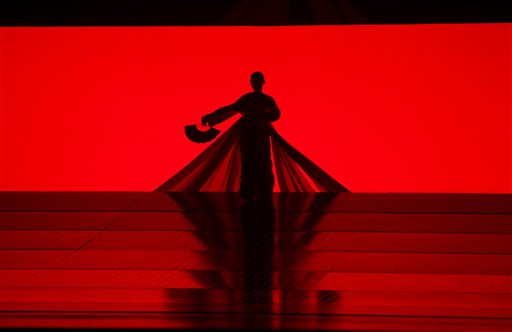
Anthony Minghella's never really done it for me as a film director because he never digs very far beneath the surface and seems to be adverse to actual perversity (e.g., The Talented Mr. Ripley, Cold Mountain), but his Madama Butterfly at the Met is stunning.

Minghella doesn't offer any new reading of the tragic story of Cio-Cio-San, the 15-year-old Japanese geisha who's seduced and abandoned by US Navy lieutenant Pinkerton, then commits suicide three years later, after Pinkerton comes back to Japan and threatens to take their son away from her. So no, Minghella doesn't interpret, he illustrates—but what illustrations! Stealing his blues and reds from the palette of Robert "If Only I Had a Heart" Wilson, Minghella unfurls one stunning visual composition after another, and salvages Madama Butterfly from the kitsch heap it so often ends up in. Butterfly's death has to be the single most striking visual I've seen all year (you only have three more opportunities to see it this season) and the use of a bunraku puppet for her son is heartbreakingly efficient. I cannot fathom why there's been so much hostility for that concept from some opera corners.

But the beauty of what's on stage never gets in the way of actual emotion, even if I do have a bone to pick with the decision to play Cio-Cio-San like a shaky, timid, virginal girl in the first act. She may be only 15, but she's also a geisha. I'd have loved to see Cristina Gallardo-Domâs at least suggest a smidgen of flirtatiousness when she meets Pinkerton. Her gradual crushing in Acts II and III would still work: Just because she's a ho doesn't mean Butterfly can't develop real feelings for her new man, as anybody familiar with Nights of Cabiria, Sweet Charity, Irma La Douce and the R&B canon will know.

If this production is indicative of the Met's new direction under Peter Gelb, count me in. Even the playbill looked better, as if the Met had finally discovered there's something called desktop publishing out there; and it wasn't all cosmetic, the content was spiffier as well. For now Gelb's strategy seems to work at least in terms of creating a new sense of urgency and relevance. Not only were there actual scalpers outside, but the crowd did look a little with it. Plus I was sitting across the aisle from Patti Smith, who may not be young and with it but still was the coolest person in the room.

Tuesday, November 07, 2006

Reno 911!

Over the past few years, Jean Reno has replaced Gérard Depardieu as the embodiment of a certain kind of French maleness in Hollywood, so much so that in the new DreamWorks/Aardman feature, Flushed Away, he voices a character named Le Frog.

When Hollywood needs a Gaul, Reno dutifully punches in his time card—except that unlike Depardieu and earlier imports such as Charles Boyer, his characters aren't sexual. I think it all started in ’95 with the horrid Meg Ryan/Kevin Kline vehicle French Kiss, in which Reno played an inspector. Then he was a French secret agent in Godzilla, a French cop in The Pink Panther and The Da Vinci Code, a French Airforce pilot in Flyboys. Lots of manly-man stuff—albeit sometimes of the bumbling kind—but not much traditional sex-ay action. Interestingly, the disappearance of the sexy French stud from American movies (except for Olivier Martinez in Unfaithful I guess) has corresponded with the years in which France has become the symbol of fey European weakness for a lot of red staters Gone are the days of Le Shaggeur, welcome to Le Frog.

This year's Goncourt

The Goncourt, France's biggest literary prize, has just been attributed to Jonathan Littell's Les Bienveillantes. I've only reached page 250 (out of 900) so will refrain from commenting for now, but a small detail buried at the end of a Libération article about Littell struck me: Apparently, the American-born author, who's lived in France and wrote his novel directly in French, was turned down for French nationality twice. That decision strikes me as ill-considered and embarrassing (I'd be curious to know on what grounds Littell's request was turned down), especially since I myself got dual French-American citizenship a few weeks ago. But of course it's only part of France's generally awkward, to put it politely, attitude toward immigration. If the Yale-educated son of a best-selling writer (Robert Littell) gets turned down for French citizenship, just imagine the obstacles put up in front of immigrants from Mali or Afghanistan. What most impressed me when I took the oath at a Brooklyn courthouse was the sheer diversity of the 400 or so people in the room with me. Of course this doesn't mean American immigration policy is so hot right now—the country is building a wall on its border with Mexico after all—but it strikes me as still more accomodating than what passes for immigration policy in France.

Saturday, November 04, 2006

Last remarks on the French trip, I swear!

This didn't feel like it belonged in the Quartett post, but there were actually other things happening in France. (I know, I know…)

• Oddball stage adaptations: There's now Bagdad Café: The Musical, adapted by director Percy Adlon from his own inexplicably overrated 1987 film. But perhaps you'd prefer Dolores Claiborne, a play based on Stephen King's novel of the same name, and starring comedian Michèle Bernier?

• Also live in the flesh in Paris: Hollywood's favorite Hire-a-Frog Jean Reno, Alain Resnais regular Pierre Arditi, diaphanous blonde Isabelle Carré, snooty brainiac Jeanne Balibar, dryly funny Catherine Frot.

• But wait, there's better: Dita von Teese was making her debut at the Crazy Horse Saloon! Like the Lido, the Crazy Horse Saloon is a Paris-style cabaret, meaning it doesn't involve Gershwin or Porter but topless ladies cavorting on a small stage while the audience dines at surrounding tables—kinda like Cristal Connors's numbers in Showgirls but, you know, with French boobs.

• What's up with Harlan Coben?!? French libraries stack his books in huge piles and every other person on the metro seemed to be reading him. Not only that, but Coben's thriller Tell No One was turned into one of the fall's big French films, Guillaume Canet's Ne le dis à personne. Actually, someone should look into how American or English thrillers often are adapted into completely different but very good French movies: Ruth Rendell's A Judgment in Stone became Claude Chabrol's The Ceremony and Jim Thompson had the honors twice: Pop. 1280 became Bertrand Tavernier's Coup de Torchon (transposed to colonial Africa) and A Hell of a Woman became Alain Corneau's Série Noire.

• And speaking of books: On my next-to-last day I gave in to curiosity and purchased Jonathan Litell's mega-hyped doorstopper, Les bienveillantes, a book mentioned as a candidate to every French literary prize. Even better, I bought it at a supermarket in the Corsican boondocks, putting it in my basket between the chestnut pasta and the yogurts. For indeed many French supermarkets carry books and CDs. Just imagine being able to buy a 900-page novel narrated by a gay SS officer at Key Food…

Crawling back into dilettantism

Yikes, vacation sure can take its toll on a blog, though it's also great to leave the web alone for a while. A few thoughts to wrap up the French trip, which was lighter on the gulcher than usual (though I'd certainly include watching Over the Hedge, which includes a brilliant voice-over performance by Steve Carell, on video).

I suppose the main event was seeing Heiner Müller's Quartett, which I've alluded to before. The text is based on Laclos' Liaisons dangereuses, which Müller has boiled down to its two key characters, Valmont and Merteuil, and to a dozen incredibly dense pages. I'd love to see it again in a production emphatically not by Robert Wilson, whose formula just feels tired and mercenary at this point—mercenary because based on the past five-six shows by him I've seen, he now applies the same predictable boilerplate tricks to whatever he's meant to stage at one of the many international houses of culture that inexplicably keep on hiring him. In the case of this Quartett, Wilson incorporated elements from two of his own previous stagings. From the 1988 New York production, for instance, we seemed to inherit the three extra characters—including an old man—and a prologue of a sort in which the actors seat at a banquet table.

While Wilson had Lucinda Childs as Merteuil back then, we had Isabelle Huppert, who was the show's main draw. The command she had over the technical aspects of her performance was astonishing, something that was obvious from her first line, which she repeated over and over with barely perceptible variations in speed and pitch, incongruously—and somehow convincingly—sounding like a spoken version of a Philip Glass piece. It's hard to talk about anything that's not purely technical when referring to actors in a Wilson piece anyway, because to him they are nothing more than elements in his visual compositions, no more or less important than the lighting, costumes or set. No wonder he makes them move slowly and adopt dramatically geometric gestures: The only obviously human component he allows them is speech (and in this case not even to all of them—of the five people onstage in this Quartett, three remain silent). In his notes on the show, Wilson explains that "en 35 ou 38 ans de travail, je n'ai pas une seule fois dit à un comédien ce qu'il devait penser en termes de texte, de sentiment, d'émotion." ("In a 35- or 38-year career, I've never once told an actor what he should think in terms of text, feeling, emotion.")

I don't actually have a problem with that approach, except that to make an impact, you need to deliver superb visuals and topnotch sound design. Alas, Wilson's well seems to have gone dry: At times Quartett felt dated, at others slightly ridiculous (and let's charitably ignore the attempts at humor). I'd be curious to see how long Wilson can continue to coast on two blue spotlights and three red frocks.

Thursday, October 26, 2006

Briefs from France

No time to post in Paris as I was busy rediscovering the city on foot (biggest change: the enormous amount of people on bicycles and the effort spent on building new bike paths), spending hours reading the paper in cafés, talking politics with friends (go Ségolène!) and going to the movies. A quick rundown:

- Christophe Honoré's Dans Paris, greeted by very positive reviews, including constant positive nods to the way Honoré honors the New Wave. And he really shoves it down our throats: a direct visual reference to Truffaut's Domicile Conjugal here, a female character named Anna there, and especially Louis Garrel's character, a sub-Jean-Pierre Léaud who didn't get the memo about how Antoine Doinel is meant to remain endearing even when he's irritating. The scene in which Romain Duris and Joana Preiss sing to each other on the phone is really moving, however, a successful Demy pastiche. But the movie tries too hard to be quirky, to be touching, to simply be. Add an awful jazz-lite score and painfully ugly cinematography, and you're left with a piece that does not bode well for French auteur cinema.

- Equally disappointing in a completely different way is Rachid Bouchareb's Indigènes, which won its four lead actors an interpretation prize in Cannes. The movie is about men from the French colonies of North Africa fighting in the French army in 1944-45, and a typical example of how meaning well does not often translate into making good. The actors are indeed excellent, though there's a credibility gap as wide as the Grand Canyon at the center of the movie: Jamel Debbouze has a lame right arm and there's no way a man with only one functional arm would have been accepted in the army, and he certainly would not have been sent to battle with a rifle. To have Debbouze in the part does not make sense, and his handicap is never addressed in the film. Insane! From there on I could not take the movie as seriously as it deserves to be taken.

- two Frenchy-French-French comedies: Eric Rochant's L'école pour tous and, er, some no-name director's Poltergay. Both are ripe for American remakes, though only the former is likely to remain the better version. In L'école pour tous, a banlieue dude poses as a French teacher in a middle school smack in the middle of an at-risk neighborhood in order to evade the police. Various shenanigans and hilarity ensues. The best part of the movie is that the main character does not really improve at the end and does not miraculously become a brilliant teacher. The second best part is director Noémie Lvovsky stealing every scene she's in as a flamboyant fellow teacher. Poltergay benefits from a brilliant title and premise (in addition to Clovis Cornillac's pecs, wasp's waist and excellent comic timing): a couple moves into a house haunted by the ghosts of five gay men who died in a disco fire in 1979. Only other men can see them. Genius! The execution does not always follow but there's nothing a team of Hollywood rent-a-hacks couldn't fix.

- Les honneurs de la guerre, a 1960 movie set in 1945 and scripted by future director Jean-Charles Tacchella. No music, very odd mood for this UFO of a film in which the French villagers are shown as pretty deluded and pathetic, especially the eleventh-hour resistants.

As a side note, going to the movies in Paris is an exquisite pleasure: The screening conditions are generally nice (and often superb) and the silence among the audience nearly absolute. None of that constant bovine munching that accompanies movies in the US, and which I am completely fed up with.

Hey, time for Desperate Housewives dubbed in French! Next post: Heiner Müller's Quartett.

Wednesday, October 18, 2006

Solar systems

I'm swamped with work before going on vacation so this will just be a brief plug for two recent Time Out reviews:

• the new Sofie von Otter CD, dedicated to the music of Benny Andersson. I wish I had liked it more since her cover of Abba's "Like an Angel Passing Through My Room" was a highlight of her collaboration with Elvis Costello, For the Stars. Still, it's nice to hear a song from Benny's underrated album Klinga Mina Klockor. Coincidentally I finally saw Mamma Mia! the same week I wrote this review. It was weird to hear all those Abba songs in a different context, i.e. to have them work as devices serving a narrative, and the show's relentlessly bright aesthetics can be tiresome, but Carolee Carmello does a great job as the mother, particularly when she wrings every last drop of outsize tragedy from "The Winner Takes It All."

• the new Solar Anus anthology, which collects this Japanese band's entire recorded output. Psych bands are jam bands for the hipster set and they tend to annoy me after a while—it probably would help if I smoked pot—but this one is relentlessly nuts.

Monday, October 16, 2006

Isabelle vs. Isabelle


A few days after blogging about the two Isabelles (Huppert, left, and Adjani) being on the Parisian stage at the same time—but certainly not the same place—I coincidentally came across a funny article exploring the very same thing. In a Nouvel Observateur piece titled "La guerre des Isabelle" ("the Isabelles War"), Marie-Elisabeth Rouchy details the actresses' rivalry, which goes back to that Brontë sisters movie they made with André Téchiné back in 1979, when their respective agents would time their screen time to make sure one didn't get more than the other. Adjani recalls that Téchiné didn't want them to wear makeup but that they always tried to sneak some on while he wasn't looking so one wouldn't look plainer than the other. (The third sister was played by the wonderful Marie-France Pisier, but you don't see her get into feuds with anybody.)

More good stuff from the article for non-francophones:

In the late ’70s, Huppert and Adjani both wanted to star in a film adaptation of Théophile Gaultier's La dame aux camélias (usually known here as Camille). Huppert won that one, but Adjani scored a few years later when she got to do a project they both coveted, the life of Camille Claudel.

Even more deliciously (and that I had totally forgotten about), Huppert starred in Schiller's Maria Stuart in London in 1996—the character Adjani is now playing in Paris, but in Wolfgang Hildsheimer's lesser-known version of Stuart's last moments.

Rouchy also tallies the actresses' Césars (Adjani's four to Huppert's one), respective filmographies (Adjani's 27 movies to Huppert's 76) and media profiles (Adjani's breakup with Jean-Michel Jarre lands her in French celebrity magazines, Huppert gets a retrospective at MoMA and a hardcover book of portraits).

Since of course it's more exciting pick a camp, I unhesitantly join the Huppertists—though it's quite fun to watch Adjani vainly try to fight Time and in the process resemble more and more a porcelain doll.

And that's the end of tonight's Star Watch.

Sunday, October 15, 2006

Frances Faye revisited

You can't really go wrong with frantic bongos. Within a minute or so of Terese Genecco and her "little big band" taking the stage at the Metropolitan Room Saturday night, and as the manic percussion was launching the festivities, it was obvious the show would generate more wattage—and fun—than an entire evening of Rufus Wainwright at Carnegie Hall.

Following a tip from the esteemed Adam Feldman, we trekked to the Metropolitan Room (a very nice place to see a show, by the way) intrigued by the prospect of a singer brazen enough to pay tribute to Frances Faye, a spirited but now largely forgotten nightclub singer whose career spanned the 1930s–’70s. Most of Faye's dozen albums are out of print, and my introduction to her came only a few years ago through Caught in the Act, which documents a Vegas set complete with oddball banter. Oddly enough, Faye is absent from James Gavin's indispensable book on the New York cabaret scene.

As Genecco makes it clear, she doesn't try to impersonate Faye. Rather, she and her smokin' seven-piece band attempt to recreate the mood at Faye's shows; they use the same arrangements (many by Russell Garcia), replicate some of Faye's nuttier flights of fancies (like tweaking the lyrics to "If I Was a Rich Man" to "If I Had a Kilo") and Genecco actually uses some of Faye's between-songs bawdy banter. During the faster numbers, I was reminded Keely Smith but also of Anita O'Day's hard-swinging Songbook albums of the 1950s and 1960s, especially Anita O'Day Swings Cole Porter with Billy May and Anita O'Day and Billy May Swing Rodgers and Hart (the latter produced by Garcia). Genecco's diction was impeccable and she never got thrown off the runaway-train melodies; unlike Wainwright, who looked and sounded as if he was struggling against the songs, Genecco—who also played the piano on some tunes—was never less than supremely comfortable with the material. And the band looked as if it was having a blast, a statement in and of itself. Let's just hope New Yorkers will catch on enough to make it worthwhile for Genecco and her band to come back soon.

Friday, October 13, 2006

A hell of a show


Les Freres Corbusier's Hell House at St. Ann's Warehouse is scary in several ways. The company that gave us Boozy (nominally about Robert Moses and Jane Jacobs, and one of my favorite shows of the past couple of years) bought a $300 Hell House kit from Pastor Keenan Roberts—who makes quite a nice chunk of change by selling them to churches who want to set them up for Halloween—and put it on with a straight face. Small groups of 10-12 people are led through a maze of interconnected rooms by a demon guide and for about 45 minutes we are exposed to what fundamentalist Christians think is scary: a girl is slipped a roofy at a rave, gets gang-raped and commits suicide; a cheerleader endures a bloody abortion; a student guns down his class, Columbine-style; two gay men get married to each other, then one of them becomes sick with AIDS and agonizes on a hospital bed (the doctor wears a yarmulke—nice touch); and so on. The production is pretty much identical to the ones staged all around the Bible Belt (though it would have been even more hardcore to import an actual Hell House complete with Christian extras); the difference is the audience, and how it perceives the Boschian tableaux.

To a proud daughter of the Enlightenment, the scariest part of Hell House is that there are quite a few Americans who take this superstitious nonsense seriously; not only that, but these smug, medieval obscurantists also feel they can tell everybody how to lead their lives. This Hell House may be designed to put the fear of god into fundamentalists—and I can only imagine how it must freak out/screw up a 14-year-old girl in the depths of Oklahoma or Colorado—but it certainly makes my secular-humanist blood boil with anger.

On a side note, Keenan Roberts' approach is very similar to that of fundamentalist cartoonist Jack Chick, whose illustrated tracts are popular kitsch items in many hipster-heathen household. Both men use popular culture to draw in their victims, and both display an uncommon amount of gleeful violence and luridness just as they make a show of demonizing these traits.

Tuesday, October 10, 2006

Missed opportunities

Considering how good the basic building blocks (book, music) in A Chorus Line are, I was frustrated by the futility of the new revival. I didn't see the original production, but everybody is in agreement that the "new" one is a slavish carbon copy. It was directed by Bob Avian, who co-choreographed the original; Baayork Lee was the original Connie and is now responsible for "choreography re-staging." Sure, it's very entertaining, and large parts of Marvin Hamlisch's score continue to send shivers down my spine, but what's the point?!?

In a weird way, A Chorus Line anticipated the reality-TV boom, with cast members talking to a director (i.e., the camera) in confessional mode, while going through a casting call (i.e. elimination process). It would have been great to dynamite the show and direct it from that perspective, like some kind of razzle-dazzle Big Brother series, but it would have taken producers with balls.

I am told there are legal reasons that A Chorus Line must be staged the same way it always is. This is the death knell for this show: It'll only endure as a period artifact preserved in formaldehyde. It could easily be staged as a biting commentary on a culture driven by ego that's both self-aggrandizing and self-pitying and by competition, but instead it remains a backstage musical frozen in 1975 amber. While this is fine—it's hard not to like a good backstage musical—it could also be…something else. One day, some British director will mount a production of A Chorus Line that brings it into the 21st century, and then everybody here will wonder why nobody had thought of it before. (Look at what John Doyle did to Sweeney Todd.)

The paucity of imaginative directors on the Broadway and upper-Off stages drives me up the wall. What's up with Scott Elliott, for instance? His Threepenny Opera on Broadway was clueless; now his Prime of Miss Jean Brodie for the New Group is a snooze. The play is full of exciting dark corners, especially in the way it deals with the confluence of teaching and domination, and the way it looks at how a charming, charismatic individual can bamboozle students into a miasmic ideology. But Elliott doesn't seem to have any point of view on the story, just as he didn't have any on Threepenny, and he contends himself with letting actors loose, hoping they'll pull through. (And when all else fails: nudity!) Alas, Cynthia Nixon (whose Scottish accent is just bizarre) is out of her depth from the get-go, lacking not only the steely undergirding required to play Miss Brodie, but also the haughty black humor the character displays at times. My neighbor was asleep within 20 minutes; lucky him.

Sunday, October 08, 2006

Everything old is new again is old again

Let's take two completely different offerings: Jay Johnson's The Two and Only on Broadway and Mikel Rouse's The End of Cinematics at BAM. I went to the former expecting little—after all, this was a one-man show by a ventriloquist whose main claim to fame was a recurring gig on the 1970s series Soap; yet I came out not only charmed, but musing about the evolution of popular entertainment, dichotomic acts, acting with voice vs. body. I went to the latter expecting to my brain cells to be activated, my sensory nerves to be tickled; I exited in a semi-catatonic state.

Anybody who's seen a Shakespeare in the Park show at the Delacorte has been subjected to a high-tech form of ventriloquism—the miking is so intense that there's no correlation between the actors' voices and their lips; actors throw their voices whether they want it or not. Jay Johnson does it the old-fashioned way: by projecting his voice onto a puppet (or a tennis ball, or whatever's handy—but usually a puppet) clinging to his arm and by establishing a straight man/demented accomplice act. Think of it as Jerry Lewis and Dean Martin's cabaret routines done by one person. That reference also alludes to these antics' antique style: The Two and Only is a trip back to a long-gone time of radio dramas, Catskills entertainment and variety-show acts. But Johnson pulls it off because in addition to the technical skills that allow him to create genuinely funny routines, he weaves in and out of a narrative touching upon the notion of old-school mentorship and the melancholy inherent in specializing in an art that not only is considered dorky but is pretty much on the verge of extinction.

Composer-director Mikel Rouse has said in an interview with my colleague Steve Smith (referring to the old Cage/Cunningham collaborations and how you could approach his own show in the same manner): "you’ve got permission to check in and check out." Fine, but Rouse's own M.O. prevents that: There's too much going on onstage—a beautiful bilevel stage, projections of images both prerecorded and filmed live, actors-singers interacting with each other and their preshot avatars—and yet none of it is particularly compelling. Why mention in the program notes Susan Sontag's article about the death of traditional cinephilia and call your show The End of Cinematics if half of it relies on purely cinematic tropes? By starting the evening with trailers of upcoming Hollywood productions (Spiderman 3, a CGI version of Teenage Mutant Ninja Turtles), are you implying that your own show isn't that different in that it's a hollow head trip defined by the technology that allows it?

The first two songs lured me in because I thought that finally a contemporary composer had successfully reached out to the world of pop electronics, but Rouse's inspiration frittered away quickly—all the songs sounded the same and the lack of dynamics was maddening (but then, dynamics would have prevented the kind of daydreaming Rouse claims he was after). Mostly the show reminded me of a jumbled mix of 1960s hippie happening, late ’80s/early’90s rave culture, Wired's wide-eyed love for gadgetry and Laurie Anderson's early work: There was nothing in The End of Cinematics that wasn't in her 23-year-old magnum opus, United States I–IV (created at BAM).

On a more general note, the show fits perfectly into BAM's current programming, which—as my friend Christian (a subscriber who walked out of The End of Cinematics) astutely pointed out—seems to increasingly fall into basic categories: American tech-heavy spectacles (Mikel Rouse, the Builders' Association), European dance-theater (Pina Bausch, Sacha Waltz), versions of classic works by international companies (Macbeth in Japanese, Hedda Gabler in German, Maria Stuart in Swedish, etc.) and neo-trad pieces (the theatrical equivalent to world music). Of course enough of the shows are good, or at least interestingly flawed, that BAM remains an indispensable institution on the NY scene. How else would we have seen Ingmar Bergman's stage work? Who else is bringing over Germany's Thomas Ostermeier, whose Nora (A Doll's House) two years ago was a great example of a flawed but mesmerizing production? Perhaps I'm harsh on BAM because I've been spoiled and now I expect too much from it.

Friday, October 06, 2006

Vivica watch #1


Oh dear, I seem to have acquired a new stage crush. Went to see Handel's Semele at City Opera on Wednesday and became completely obsessed with Vivica Genaux, who sang the dual parts of Ino and Juno. Summoning all my critical faculties and the immense vocabulary at my disposal, I'll offer the following assessment: She's hot hot HOT!

This production of Semele should be forced upon everybody who thinks opera is boring—a more entertaining evening is hard to find in town (at least on that particular Wednesday night, since the performance I caught was the last one). Director Stephen Lawless transposed the action to the early 1960s, with Semele as Marilyn Monroe, Jupiter as JFK and Juno as Jackie K. It was a masterstroke because it fit the plot so perfectly : Ambitious Semele dumps her sensitive (read: countertenor) fiancé for powerful alpha male (duh, he's a god!) Jupiter; meanwhile, jealous Juno tricks Semele into committing a fatal mistake (represented in the show by a pill overdose). The whole thing zipped along for its entire three-hour length, with Lawless always striking a perfect balance between humor and genuine pathos. Sure, Elizabeth Futral didn't sound all that comfortable at times in the title role ("The morning lark to mine accords his note/And tunes to my distress his warbling throat"—warbling throat indeed!) but she barreled through on sheer personality and by acting up a storm. But my heart was stolen by Vivica, who not only looked, er, what I said before, in her little pillbox hat, but also sang rings around La Futral.

Reviewers and bloggers seem to suggest Vivica was mugging and making faces. I have to disagree. The thing, you see, is that technically speaking nothing much happens in a baroque aria. Most of them repeat 2-3 sentences over and over, sometimes in their entirety, sometimes in fragment. (As an aside, I've been musing about how great it'd be if contemporary musical-theater composers took their cues from that style instead of coming up with all these cumbersome, narrative-heavy dirges. I'll refine this thought in a further post.) In addition, and particularly in a case like Semele, it's friggin' impossible to follow the plot without a synopsis because the opera's so elliptical. In order to get the plot moving—and even clarify what was going on—Lawless had those onstage but not singing during an aria move around and, yes, act. Act! Has this become anathema at the opera?!? It made sense for Vivica to act while someone else sang as a way to express what her character was thinking/feeling at any given time, and she never did it in a way that distracted from whatever else was going on; it was just a nice little treat to those paying attention, and it made dramatic sense. It's called reactive acting, people! Too many lazy theater and opera directors focus only on whoever singing/speaking at any given time, leaving those sharing the stage to just stand there. How lazy can you get? Directing doesn't involve only coming up with basic blocking and telling whoever's in the foreground "Now you pretend to be sad/happy/frustrated/angry." Lawless had a concept that fit the opera, then he had his actors interact. Is it so rare nowadays that it can be misinterpreted as making faces?

Wednesday, October 04, 2006

Gérard talks

I'm just dying to go on and on about some shows I've just seen (The Prime of Miss Jean Brodie at the Acorn, A Chorus Line on Broadway and ¡El Conquistador! at New York Theater Workshop) but I must refrain until my TONY colleagues' reviews come out.

In the meantime, here are a few translated nuggets from a great interview Gérard Depardieu gave to the French weekly Les Inrockuptibles a few weeks ago. The piece is pegged to Depardieu's latest movie, Xavier Giannoli's Quand j'étais chanteur, but it covers his entire career—which, lest we forget, includes movies by owlish French authoress Marguerite Duras and Italian nutjob Marco Ferreri—and Gégé talks like someone who really couldn't give a shit what people think.

• About producing some of his own movies:
"On La Chèvre [1981], for instance, I really felt I got screwed by [producer] Alain Poiré. He didn't want to pay for three plane tickets so that Elisabeth and the kids would visit me on the shoot. And when the movie made millions, he got [director] Francis Veber, [costar] Pierre Richard and myself together and gave us keyrings [laughs]. Well, all right then! (…) Working on La Chèvre was a turning point since before that I was labeled an 'intellectual actor' because I worked a lot with Duras. Yet I always thought of her not so much as intellectual as earthy. And she was a lot more manipulative and grounded than the people who claimed her a genius. But she was a genius, whom we'll still talk about in 500 years. Whereas I'm not so sure about Marguerite Yourcenar, for instance."

• About having to sing in his new movie:
"I learned to sing with [director Claude] Régy. I found it really immodest, I couldn't do it. I had to do it for a Peter Handke play, Les gens déraisonnables sont en voie de disparition. Before that, even drunk it wouldn't have occurred to me. But I learned to do everything on stage. I've even been able to sleep. I woke up, saw Andréa Ferréol, who was only mildly bothered, I waited a beat and went back to acting. I'm telling you about it because I don't think it matters."

• About his relationship with Godard on 1993's Hélas pour moi:
"I remember a chat on a dock in Lyon. We talked for two hours. He kept bugging me with the word star. I told him, 'Truffaut is right, it's normal that you don't have any balls because they've been crushed, but I can't believe how Protestant you are. You're far from being a thug.' Godard's problem is his relationship with money: He wants to get dough, pull off robberies, but then he's afraid. You can't be afraid. When you're paid seven million to make Hélas pour moi without a script, you've got to take them without thinking twice about it."

• About meeting Marco Ferreri:
"The first thing he said to me, with his Italian accent, was, 'Are you temerarious?' I was on my way to pick up some money for expenses, he had just gotten his. All these people were tight with their money. I loved these communists around 1975–76, like Bernardo Bertolucci, who drove a Benz. Bernardo said to me, 'But my Benz is red!' He had a great sense of humor back then. Marco, on the other hand, was a real pain in the ass. He kept it all in, he couldn't even shit. With Marcello [Mastroianni], it really made us laugh."

• About distributing Satyajit Ray's movies:
"I went to India and I wanted to create a Ray Foundation so that his movies would be kept together. I coproduced his three last movies with [Daniel] Toscan du Plantier. I remember that he told me that E.T. was one of his short stories. The biggest hit in American cinema comes from India! He'd sent the script to Columbia way before. When you read it, all E.T. is in there. Of course, no rights were ever paid."

• About Hollywood:
"Hollywood is full of bourgeois. Even worse: Bourgeois who, for the most part, dream they are hoodlums or thugs. A bit like Godard."

Monday, October 02, 2006

Deutsch-Französische Freundschaft


A twist on an old German favorite, DAF (Deutsch-Amerikanische Freundschaft), for two German-related items.

• Score! My friend Alexis managed to get us tickets to the Théâtre de l'Odéon's production of Heiner Müller's Quartett, which is based on Laclos' Liaisons Dangereuses. It's staged by Robert Wilson and stars Isabelle Huppert and Ariel Garcia Valdès. I was looking forward to some R&R in Paris in October, and now the trip will be even more interesting. No matter what you think of Huppert, nobody can deny that she takes risks, unlike, I may add, her contemporary Isabelle Adjani, also on the Paris stage but in a rather different vehicle, Marie Stuart—not by Schiller but by an obscure German playwright, Wolfgang Hildesheimer. And to think Adjani played Emily to Huppert's Anne in André Téchiné's Les Soeurs Brontë (1979). Their careers could not have taken more different paths since.

Alas, timing does not only play in my favor, and I'll miss some interesting-looking items in the Festival d'Automne, especially Marcial Di Fonzo Bo's latest evening of plays by Copi, and Romeo Castellucci's new piece, Hey Girl!, which runs in November. Anybody who saw Castellucci's Tragedia Endogonidia: L. #09 London Portrait at Montclair's Kasser Theater last October has got to be dying to see more. Why oh why can't Lincoln Center, BAM or St. Ann's Warehouse bring him and his company, Societas Raffaello Sanzio, over? L. #09 didn't have anything resembling a plot or characters but it was the kind of full-on theatrical experience that remains branded in one's head.

• Read in the latest issue of The Wire that German director Hans-Jürgen Syberberg's 1978 movie Hitler: A Film from Germany is online. You can see it here for $1, which goes toward the restauration of the Nussendorf church tower and is rather cheap for a seven-hour-long reflection on the medium of film as much as on Germany. Syberberg is one of the great directors of the New German Cinema of the 1970s and 1980s, albeit the least well-known in the US. Susan Sontag wrote at length about his masterstroke in The New York Review of Books, starting with "Hans-Jürgen Syberberg's Hitler, A Film from Germany is not only daunting because of the extremity of its achievement, but discomfiting, like an unwanted baby in the era of zero population growth." You need to pay $3 for the rest of the piece, but you can get an idea of its gist based on these letters to the editors, followed by Sontag's response. Her line about how "The need to reduce the work of art to its message obfuscates the character of its artistic lineage" resonates still.

Friday, September 29, 2006

Gutenberg! The Musical!

A good comedy is hard to find, so thank the (atheistic) heavens for this offering at the New York Musical Theater Festival. I actually first saw it last year at UCB, where it was performed by its two authors, Anthony King and Scott Brown, and I had such an unexpectedly good time (unexpected because I'm usually suspicious of shows with exclamation points in their titles) that I went back for seconds. It also helped that the NYMF production stars two superb actors I was keen to see—Jeremy Shamos (most recently of Trouble in Paradise) and Christopher Fitzgerald (Wicked, Saturday Night).

Gutenberg! The Musical! isn't so much a proper musical as a play with songs. Since it's set up as a backers' audition, in which Bud Davenport and Doug Simon, the authors of the show within the show, try to lure Broadway producers, the bargain-basement production values are integrated in the premise: This is a show that must be done on the cheap. There's only a pianist, no sets, no costumes (baseball caps with characters' names written on them are as close as it gets) and almost no props (the press is a cardboard box).

So yeah, Gutenberg! is about putting on a show about Gutenberg, the inventor of the printing press; his love affair with a wench named Helvetica; and his run-ins with an antagonistic monk ("Monk"), an antisemitic flower girl and various town drunks. There's not much to it, but the songs are dead-on in their mimickry of a certain bleating pop-Broadway style and the actors switch between characters with deadly comic precision.

There are two more performances on Saturday. Go and see it for $20, before someone turns it into the next [title of show] and starts charging $60.

Wednesday, September 27, 2006

Signé Chanel

Loïc Prigent's extraordinary serial (i.e., five half-hour episodes) doc is now showing on the Sundance Channel and is not to be missed. (Click here for schedule details, but if you read French, click there for better info on the series.)

Originally produced for the French-German channel Arte, Signé Chanel follows the famous house in the weeks leading up to the showing of its Fall/Winter 2004-2005 collection. You see a bit of Karl Lagerfeld in action, of course, but Prigent concentrates on the dressmaking studio at the top of the rue Cambon building occuppied by Mademoiselle Chanel's house.

The show isn't about the creepy German dude who dreams up the clothes, or the rich and powerful who buy them, or the parasites who gravitate around fashion (though there are a few highly satisfying shots of the preposterous Andre Leon Talley, gushing like only a fawning courtier can). No, what makes Signé Chanel stand out is Prigent's affection for the people who turn Lagerfeld's sketches into actual clothes. It's about the likes of Madame Martine, Madame Cécile and Madame Laurence, who cut and sew and literally bloody their hands for the sake of a dress, and about 75-year-old Madame Pouzieux who, in-between bringing in bales of hay, makes unique braids on an antique loom in her farm house. The show also covers the superstitions and customs of a highly artisanal industry—dropping scissors is an augury of death, for instance, and the significance of pricking your finger with a needle depends on the finger and whether it's on the left or right hand.

From a purely aesthetic point of view, the series is a pleasure. Prigent has a great eye—not only for human interaction, but also for elegant visual compositions. Several of the shots in the series made me gasp in wonder, and I don't even care that much about fashion. He's also a master at parallel editing, building tension, capturing expressions and offhand comments.

A good deal of the humor is as aural as it is visual. Monsieur Lagerfeld, for instance, is associated with a vaguely sinister, faintly Darth Vaderish musical theme; Prigent also makes great use of the way Lagerfeld (wearing high collars to hide his chicken neck, perhaps?) constantly clinks the numerous rings he wears. When the worker bees' load increases and their schedule becomes frantic, the director uses music that sounds as if it was lifted from a 1960s peplum, suggesting galley slaves sweating away on their oars.

As it all culminates in the final episode's défilé, it's hard not to feel proud of the white-coated workers. High fashion serves the mighty, the ones who can afford dropping tens of thousand of dollars on a garment. It'd be easy to have a moral problem with squandering that much money on a suit, but as a lover of the arts it's also hard to take issue—art needs patrons, after all. Besides as the series makes clear, not one of the women seating at the défilé has a tenth of the talent and dignity of those who make their clothes.

Sunday, September 24, 2006

Of singing nuns and Freudian slippers


The New York Musical Theatre Festival is in full swing and I caught two shows over the weekend, with a (non-NYMF) performance by Justin Bond and the Freudian Slippers in the middle.

The Tragic and Horrible Life of the Singing Nun, appropriately presented at the Theater at St. Clements, is a musicalization of Blair Fell's play of the same name, which I actually saw in 1996, back when downtown was alive with campy little plays. Fell (also responsible for the live soap Burning Habits) wrote the book along with "additional lyrics" to Andy Monroe's songs. While in too many new musicals the songs are, sadly, the problem, Monroe has come up with a number of ’60s-influenced gems. The production also benefited from a nimble cast, notably Laura Daniel in the title role; Tracey Gilbert's as the Singing Nun's enduring love, Annie Nevermind; and Kristine Zbornik as Mother Helen Lawson. Yep, Helen Lawson: Fell's driving idea is to superimpose the life of the real Singing Nun with elements from Valley of the Dolls, like an Ethel Merman–esque Mother Superior and a hunky love interest called Lyon. Some of it works, especially "Superior," a fab number belted in great style by Zbornik, but at times the camp factor feels dated. Most glaring in that respect is the use of a drag nun, Coco Callmeishmael (Stephen Michael Rondel), as a narrative device. I'm not actually sure that character—who drags (ba-dum-bump!) down the action more than anything else—is needed at all. Opting for camp also means that Fell, who has a real talent for quickly switching from zany humor to heartfelt emotion, paints himself into a corner when the second act, following the Singing Nun's real life, turns to tragedy: There's no good way for him to handle the drastic change of tone that follows the intermission.

I also trekked to the Sage Theater for Oedipus for Kids!, a disaster I'd describe as being of Titanic proportions if the show's ambitions weren't so tiny. The premise is simple: A troupe putting on adaptations of classics for kids decides to do a musical version of the Oedipus story. Kimberly Patterson (book), Robert J. Saferstein (music) and Gil Varod (lyrics) managed to stretch that kernel of an idea to two mindnumbingly dull hours, during which we endured such lyrics as "Whatever Oedipus touches, Oedipus wrecks." There were references to baklava and spinach pies as well. The experience reminded me of the Fringe in that the show was based on a single, juvenile idea that should have been cast off after everybody had sobered up. Of note: cast member Laura Jordan had broken her ankle a few days before and performed seated on a rolling office chair. She was the best one, too.

Oh, and one last peeve: The actors were miked even though the Sage is tiny. Come on, people, work a little! Being miked in such a small space is completely preposterous. If you can't project, get off the stage.

I almost hesitate to mention Justin Bond in the same breath, but this post is dedicated to the weekend's revelries and technically he performed on Saturday morning. Bond, known by many as the illustrious Kiki, of Kiki and Herb, lit up the Spiegeltent, backed by a merry band of youthful mercenaries who seemed on loan from Juilliard and looked on the proceedings with a mix of bemusement and astonishment. (And sometimes they didn't look on at all: Around 2:30am, I noticed the flutist had fallen asleep on her chair and had to be discreetly nudged awake by the cellist.) The set was mostly mellow—meaning none of the rockier numbers Bond has been known to do, such as Pulp's "I Spy." We did get a cover of Kate Bush's latest, "King of the Mountain," and even when he floundered through forgotten lyrics (an attempt to do Marianne Faitfull's "Times Square" had to be aborted, despite Kenny "Herb" Mellman coming to the rescue on the piano), Bond remained magnetic.

And though the music stuck to chronicling the down and out and outcast in a torchy mode, Bond, one of the quickest-witted performers you could dream of seeing, balanced it with banter that had enough acid to wipe out entire swaths of forest, as if he was the bastard child of John Rechy and Margo Channing. You could picture him throwing Margo's lines ("I'll admit I may have seen better days, but I'm still not to be had for the price of a cocktail, like a salted peanut") and infuse them with a hundred new seedy meanings; come to think of it, some clever director should cast Bond in a stage version of All About Eve. A girl can dream.

Thursday, September 21, 2006

Theophilus North

Let's hope Keen Company's production of Theophilus North doesn't fall by the wayside, brushed aside by the wind tunnel created by its faster, louder neighbors in the nascent fall season.

Matthew Burnett's play is based on Thornton Wilder's 1973 novel of the same name. (The book was turned into a movie in 1988, the impressively cast Mr. North.) By modern standards, Wilder's quaintly whimsical tale of the titular New Jersey teacher getting bogged down in Newport, Rhose Island, on his way to see the world isn't "edgy." But it's this very lack of anything resembling hipsterism that feels almost revolutionary at this point. Keen artistic director Carl Forsman and actor Giorgio Litt, in the title role, do a great job of suggesting that Theophilus' intrusions in the lives of his new neighbors often come burdened with an unspoken sense of superiority, but the character remains likeable because he always means well—and this is the kind of motivation you hardly ever seem to encounter in art these days. The creative team also never takes away from the sense of awakening to the world that permeates the work.

Theophilus North plays until October 14 at the Clurman on Theater Row.

Monday, September 18, 2006

Armchair travels

Two ways to experience non-American culture this weekend: The culturally correct one…and the other one.

On Saturday, I trekked to the Japan Society to see Yubiwa Hotel's Candies: Girlish Hardcore. It's hard to define—a bit of performance, a bit of dance, a bit of theater—but it also didn't really add up to the sum of its parts. Considering that the Japanese have pushed the boundaries of both hardcore (in its sexual, visual and musical expressions) and girlishness (through kawaii imagery and its constant evolution, for instance), the show, created and directed by Shirotama Hitsujiya, was oddly flaccid. I don't mind a lack of narrative backbone at all, but you have to compensate with arresting visuals. A couple of them did rise to the top: A crouching, naked woman, her back to the audience, excretes batter onto a hot plate; it cooks into a pancake, which is messily eaten by two other women. And in the finale, the five performers slowly stripped to their underwear while smoking and executing a line dance; the scene was made slightly spooky by the repetitiveness of the movements.

Sunday evening was a completely different experience with stand-up comedian Gad Elmaleh making his NYC debut at the Beacon Theater. Elmaleh, who was born in Morocco, is hugely popular in France, and the Beacon was packed to the rafters with a red-hot crowd on the verge of hysteria. The show went on for almost two and a half hours and Elmaleh was feted like a rock star, complete with requests for skits, people shouting out lines the way some sing along at rock shows, and cries of "You're the man of my life!" The highlights for me were his take on French R&B singing and French musical theater, but really you can never go wrong with physical comedy (Elmaleh is incredibly agile) and Twingo jokes. Bummed he didn't do the ski skit but fortunately Youtube has it, along with Elmaleh and Jamel Debbouze's fab parody of raï superstars Faudel and Chem Mami.

Much of the non-English-speaking art we see in NYC comes to us through semi-official channels—the French Alliance, say, or Scandinavia House or the Goethe Institute or the Japan Society. Or we get our high-brow offerings from BAM or Lincoln Center, whose producers scout international festivals around the world. All good stuff, sure, and the audiences usually bring together Americans and citizens of whatever country is represented; everybody is on their best behavior—Americans because they don't want to look culturally xenophobic, and "the others" because they feel the piece they're watching somehow turns into an ambassador of their home culture.

But there's something to be said for being at a show with your peeps (as you can tell from the success of the Blue Collar Comedy Tour), especially when you live abroad and a mainstream star from back home is visiting. To start with, the crowd coheres in a completely different manner. This happened when I went to see Hong Kong Repertory Theatre's Love in a Fallen City a few months ago. The play was really entertaining, but I can't possibly have enjoyed it as much as the Chinese audience—and that's okay, not everything has to please everybody. This kind of show also plays out as a benign version of homesickness-curing nationalism, the kind it's easy to get behind because nobody gets hurt. At the Beacon it was totally satisfying to laugh at a Twingo joke and not have to explain what a Twingo is, and I felt super-French in a way I hadn't experience since, I don't know, that weasel cover of the New York Post.

Saturday, September 16, 2006

Two red aunts on the loose

Despite being bone-tired on Friday night, I dragged myself to Magnetic Field, on Atlantic Avenue, to see Two Tears, a band that had come to my attention only last week. I had noticed the name on the Magnetic Field website as I was looking up their band schedule for the Atlantic Antic fair on Sunday (MagField is a great rock bar, staffed by the nicest people on earth, or at least in Brooklyn; please drop by for a drink and a song). For some reason the name Two Tears caught my eye and I looked it up, only to discover it involved Kerri Davis, who used to play guitar and sing in the Red Aunts. Suddenly it became imperative I see them.

I wrote fairly regularly about L.A.'s Red Aunts in the ’90s (these pieces aren't online, except for this old Time Out review), and nearly a decade after they split, they remain one of my favorite bands from that time. Unlike quite a few faves from back then that now make me cringe (most of the K stuff), the Red Aunts' albums endure as masterpieces of anarchic scuzz . They barely made it to the 30-minute mark (the back of my favorite, 1995's #1 Chicken, boasts "14 songs 23 minutes") and the accompanying live shows were incendiary. A lot of dude-type critics derided the Red Aunts for the fact they couldn't play—which is true, they were barely adequate instrumentalists—but technique was never the point with them, and even as they improved, they still showed no interest in writing complete songs. They didn't seem to capture the girl imagination the way the riot grrl bands did, either, perhaps because the Red Aunts didn't have a message, they were more like nihilistic juvenile delinquents screaming themselves hoarse about how they could kick your ass and not even give two shits about it.

The MP3s on the Two Tears website are more in a garage vein and less screechy, though Davis's tunes continue to be under two minutes with no discernable structure. Live, I was delighted to see that…could it be? YESSSS! The bassist was another Aunt, Debi Martini—aka EZ Wider, aka Connie Champagne, aka Debi Dip—now with longer hair but the same stance, impossibly cool with her back half to the audience. She and Davis even still wrote the set list on their forearms in black Sharpie, the way they did in the Red Aunts. The set was short and rocking, it could not have been a finer Friday-evening show. Alas, it looks as if it's going to be the last Two Tears gig for a while, as EZ Wider informed me afterwards that Davis is moving to Dubai.

The other two bands on the bill were a lot of fun as well, even if I didn't have the same sentimental connection. Locals Imaginary Icons and Michigan's MHz share a member and a taste for arty, sharp garage-punkitude, similar to early Pere Ubu. MHz's guitarist-singer Andy Claydon also runs Flying Bomb Records and was kind enough to hand me a label comp CD and a single by old Michigan faves Bantam Rooster. Loot!

Friday, September 15, 2006

Thursday-night brutality: Celtic Frost & 1349


It was an awesome one-two punch of an evening at B.B. King's yesterday. I had just swallowed the last bite of my pretzel and stepped into the club when the second opening act, 1349 (pictured) got on stage, at the unmetallic hour of 8pm and with all the house lights blazing. (I can't even fathom when first opener Sahg went on. Tea time?) What a sight: They were all in corpsepaint and half of them wore huge spikes on their wristbands. And what a great show! It's not a diss to say that 1349—named after the year the black plague hit Norway—plays textbook black metal. The Norwegian band takes the genre's basic elements (speed, growls, buzzy guitars), throws them into a caldron of bile and spits them out in three-minutes orbs of blackened hatred. No keyboards, no epic suites about Azazel or the distant moons of Pluto—just savage focus and grim, charismatic grandeur (1349 superbly ignored an audience member who taunted them in a parodic high-pitched screech).

The best part is that because the gear of headliner Celtic Frost was already on stage, 1349's drummer was sitting upfront and we could all watch in awe as he carpetbombed the club with double-bass action while his hands flew so fast that his sticks were a blur. While the legendary Frost is 1349's regular drummer, this dude didn't look like him—which I could tell not because I recognized his corpsepaint pattern let alone his face, but because his hair was suspiciously American-curly, not Scandi-straight. (This kind of detail is extremely important in metal, in which men keep their hair long and silky, perhaps in order to better execute hair windmills.) That human beatkeeping machine turned out to be one Tony Laureano, who's spent some time in Nile and Dimmu Borgir—I had in fact seen him play with Dimmu at Ozzfest a few years ago, but he hadn't made quite the same vivid impression as he did yesterday.

After Emperor back in July, Celtic Frost confirmed that 2006 will be remember as a very good year for live extreme metal. The quartet came on a little after 9pm. As vocalist Tom Gabriel Fischer (a.k.a. Tom G Warrior, and one of the best rock vocalists around) put it when he introduced the beginning of the band's US tour in his blog, "Finally we will be able again to convey the dusk of our musical processions to the masses that have been deprived of sufficient morbidity for so long. They shall never forget."

That is an understatement. Boris et al. can just go back to their training wheels: The Swiss vets know heavy. Steve Smith put it best (by way of Strapping Young Lad), describing the band's incredible reunion album, Monotheist, as heavy as a really fucking heavy thing. And live, it really was super-duper double-skull-penetration heavy.

They started on the dirgey side with "Procreation (Of the Wicked)," from Morbid Tales, but then picked up the pace and delivered a half hour that was as perfect a balance of doomy and thrashy as anything I've ever heard. They then returned to the slower mode, and never were less than majestic. When Fischer roared "Oh God, why have you forsaken me?" during the mammoth "Ground," my mind flashed with visions of Hannibal crossing the Alps, hammers of the gods pounding away—a whole array of visuals that seems to have been conjured up from my role-playing days. (It was in college and we played the arcane Chivalry and Sorcery, not the mundane D&D, thank you very much.) The set ended with Monotheist's "Synagoga Satanae," a track which had not particularly caught my ear on record but was a filthy slow burn live. No encore, and they left to the tune of Frank Zappa's "The Torture Never Stops" on the PA. Nice touch.

In non-metal news, the six finalists of the Man Booker Prize have been announced, and I realized I've actually read two of them. The Night Watch isn't Sarah Waters' best novel by far; its backward structure (from 1947 to 1944 to 1941) means that Waters has to contort herself in order to avoid revealing in the first part things that need to be surprises in the last. But the description of London during and right after WWII is very compelling, and the period details anchor the story without ever drawing attention to the painstaking research that no doubt went into gathering them. The second finalist I read is Kate Grenville's The Secret River, which follows a Thames bargeman and his family as they are forcibly moved to Australia in 1806, and they settle by the Hawkesbury River—where they dislodge the local aborigines. The consequences are dramatic, as you might expect, but Grenville's lush prose makes the book both realistic (the early bits about the life of a bargeman are pretty great) and magical. And just when you think it's all going to end in tears, Grenville pulls back slighly in a bittersweet way.

Thursday, September 14, 2006

Nathalie Baye, Bruce Wagner, Miranda July

Two more short pieces in Time Out New York:

• an interview with Nathalie Baye, an actress I like a lot more now than in her ’80s prime. She currently stars in Xavier Beauvois' excellent Le Petit lieutenant, and proved to be a smart, articulate interview subject.

• a quick review of Bruce Wagner's Memorial. I'm a bit surprised by the rash of reviews that say that Wagner has mellowed out, that he likes his characters more and that his tone isn't as misanthropic as it used to be. This misreading is based on the fact that Memorial isn't a Hollywood-industry novel. Most Hollywood novels are assumed to be cynical, even though they usually aren't; since Wagner directed his spotlight somewhere else, critics interpreted the change of focus as corresponding to some sort of renewed faith in humanity. Wrong! Most of the characters aren't obnoxious, true—they are weak, deceiving, pathetic. Wagner puts the elderly Marjorie through a 2006 SoCal version of the stations of the cross, which escalates until the old woman loses everything (including, most humiliatingly, control over her bowels). Marjorie's son is a location scout who develops an addiction to painkillers after being punked by a so-called friend. Her daughter is an architect who can't seem to get anything built and ends up getting impregnated by the tycoon whose memorial job she'd been courting. Through it all, Wagner's command of language sends me in an envy-fueled funk. What I wouldn't give to be able to be able to come up with his chapter on Zaha Hadid!

In other reading news, I was actually able to finish a short story in The New Yorker. After music, video, performance art and film, Miranda July has turned to fiction. Set in—where else?—Portland, Oregon, her effort, "Something That Needs Nothing," reads like an anomie-laden version of something from an early-’90s riot grrrl zine crossed with an Adrian Tomine comic; it's greatly effective because July knows teenage girls' hearts.

Tuesday, September 12, 2006

Ave Caesar


For some unfathomable reason (sinking Empire? Class-divided society in which the rich lose themselves in McVillas and futile pursuits?), I rented Caligula, the 1979 epic attributed to spaghettisploitation master Tinto Brass (based on a script by Gore Vidal) and re-edited by Penthouse overlord Bob Guccione. Uncoincidentally perhaps, a Caligula voiceover claims "I am all men as I am no man and so…I am a God" while at the exact same time the name "Bob Guccione" appears in the credits and Prokofiev's "Dance of the Knights," from Romeo and Juliet, swells in the background. Since this follows an opening scene of Caligula frolicking incestuously with his sister, Drusilla, the overall effect actually is awe-inducing in its baroque nuttiness and sense of an ego run amok.

And it's hard to get nuttier or run more amok than this artifact of the late 1970s, a time when you could do a movie loaded with sexual and moral perversity on a big budget and with actors such as John Gielgud, Peter O'Toole, Malcolm McDowell and Helen Mirren (pictured above, but in another Caligula project; read on). We'll never know what the film would be like had Brass made it the way he wanted, but after Guccione took control of the editing room, the result was a sometimes fascinating, sometimes revolting, sometimes boring mix of narrative confusion, visual looniness, jumbled political message and hardcore-sex inserts. Aesthetically, Caligula is equal parts Fellini bacchanalia (art director Danilo Donati seems to have recycled quite a few frocks and wigs from his own work on that director's Satyricon), Studio 54 disco and Harkonnen planet Giedi Prime as shown in David Lynch's Dune.

Some of the best scenes are at the beginning, when Peter O'Toole's Tiberius—his too-small black wig half-covering his head, open sores festering on his ravaged face—shows McDowell's Caligula how to entertain himself and spits out lines such as "Serve the state, Caligula, although the people in it are wicked beasts," while in the background conjoined twins have sex with drugged-looking courtesans. Shortly thereafter, John Gielgud's character kills himself, no doubt because by then Gielgud had realized what he'd signed up for.

It would be great to be able to say that Caligula is a violent political masterpiece that now offers us a distorted mirror of the Bush administration's down spiral into ineffectual decadence and fraught Empire-building, but alas that is not the case. Rather, it is a fascinating bit of film history, testifying to a time when it felt as if the graphic representation of realistic sex was becoming an option in the mainstream. With the recent release of similarly frank—in their depiction of sex, not their cruelty—flicks by the likes of Catherine Breillat (Romance, Anatomy of Sex), Michael Winterbottom (9 Songs), Vincent Gallo (The Brown Bunny) and, soon, John Cameron Mitchell (Short Bus), maybe we're trying to catch up to the ’70s.

In any case, I'm not the only one with Caligula on her mind: Italian artist Francesco Vezzoli had a short titled "Trailer for a Remake of Gore Vidal's Caligula" (featuring Helen Mirren, back for seconds and pictured in this post's photo, along with Vidal and, er, Karen Black) in the 2006 Whitney Biennial.

A worthy addition to the roll

A quick post to welcome my esteemed colleague David Cote, Time Out New York's theater editor, to the wonderful world of blogging. He can be found at Histriomastix. Check out what he has to say about the NYC stage—which is in great need of the kind of non-sycophantic observations David is sure to supply.

Sunday, September 10, 2006

Studio 60 vs. 30 Rock

I've been intrigued by two upcoming NBC series, the Aaron Sorkin drama Studio 60 on the Sunset Strip and Tina Fey's sitcom 30 Rock, both of which start with an identical premise: the backstage shenanigans at a Saturday Night Live–like show. So I managed to get my mitts on screeners of the pilots and proceeded to spend some quality time in front of the tube.

Let's get one thing out of the way: Tina Fey is one of the most overrated people in television. During her reign as head writer on SNL, she brought the show right back to the dark days of the 1980s. She's not half as sharp as she thinks she is, as illustrated by the half-baked Mean Girls (Heathers is vastly superior on all counts). Now it looks as if 30 Rock (which starts in October) will bring the day of reckoning. Granted, what I saw is not what's going to air, since it was reshot with Jane Krakowski replacing Rachel Dratch as the star of The Girlie Show, the show within 30 Rock.You can howl til you're blue in the face about how the network traded idiosyncratic indie-type Dratch for a more beautiful woman, but Dratch was woefully out of her depth and Krakowski actually is a versatile comedienne. Fey is another matter: She gave herself a prominent role in the series, in addition to writing it, and her limitations are already showing. It's highly unlikely she has what it takes to write a satire of the kind of show she herself used to do, so 30 Rock is probably going to turn into a benign workplace comedy similar to Newsradio. We're two months away from Thanksgiving but the turkey's already landed.

Studio 60 on the Sunset Strip also suffers from dead weight at the middle, namely the wooden Matthew Perry and the wet blanket known as Amanda Peet. The latter is meant to play a wunderkind network prez but alas she emits all the steely charisma of frozen haddock, and in some weirdly lit scenes her prominent, blindingly white central incisors kept reminding me of Klaus Kinski in Werner Herzog's Nosferatu.

That said, the episode I saw is well written and oddly gripping, especially Judd Hirsch's impassioned hijacking of a live broadcast—followed by reviews calling it a Network-like incident, a comparison you should expect to see in every actual write-up of the show as Sorkin cleverly feeds critics the image of himself as a modern-day Paddy Chayefsky. Sarah Paulson, aka Mrs Cherry Jones, is promiding in the part—apparently inspired by Kristin Chenoweth—of a Christian with decent social views. I don't have any pre-conceived opinion about Sorkin, having successfully managed to never see more than two minutes of The West Wing, but Studio 60 (starting mid-September) shows a bit of promise, especially if it explores base compromises in network television and the inanity of live sketch comedy. But considering that abortion still isn't an option on American television, I doubt Studio 60 will have genuine fangs (unlike Amanda Peet), limiting itself to the usual biteless bark about the media blah blah blah.

Wednesday, September 06, 2006

A quick one while she's away

Since I've been too busy—oh all right, I was driving around upstate New York, looking for the finest donuts in the lake region—to post, here are links to a few bits and bobs I wrote for Time Out New York: reviews of Louise Welsh's Scottish noir Bullet Trick and Girl Talk's mash-up CD Night Ripper, as well as a profile of the lovely Nina Hellman, one of the brightest lights of downtown theater.

Friday, September 01, 2006

The calm before the storm

Visiting non-English-speaking family and, frankly, not that much going on have combined to ensure limited outings in the past few days. Things will pick up soon though: I've just realized with no little trepidation that the two weeks following September 9 are booked solid already. I guess that's what Emergen-C was invented for.

I'll use my last shreds of free time to finish James Lee Burke's latest Dave Robicheaux novel, Pegasus Descending. I discovered Burke on a trip to Louisiana about three years ago, and was immediately taken with his Cajun spin in American noir. Burke's plots are better than usual (and he doesn't glamorize Robicheaux, an alcoholic cop with a penchant for bursts of destructive rage) but I especially love his relentless attacks on Louisiana's corruption and its crushing poverty. The latter is what I remember most from driving through the state's backwood parishes. America can flex its muscles all it wants, but cruise half a day on roads littered with abandoned rusty appliances and punctuated by pitiful casinos and drive-by daiquiri shacks, and I guarantee you'll drop into a funk rather different from the one advertised in the va-va-voom French Quarter (which I actually found rather depressing, full as it was of fratboys drinking vats of beer at 11am).

Burke is to Louisiana what Carl Hiaasen is to Florida. Both use the crime-lit framework to ram into their respective state's foibles, though Hiaasen opts for a lighter, farcical approach, while Burke is downright Greek in his perception of Louisiana. The state he describes is mired in the 19th century, paralyzed by antediluvian class and race structures. Forget about Jay McInerney: If Burke wrote "literary" novels about New York society, he'd be ranked as one of our era's most biting, clear-eyed chroniclers. But he writes about a middle-aged cop in Iberia Parish, so he doesn't get full-page reviews in opinion-defining newspapers. That's okay: Readers with an inquisitive mind know where to find him.